Gooday everyone,
Welcome to the Deacon Corner. If you’re new here, this space dives into the inspirations behind the images you’ll find throughout the books on these pages. What began as a place to share commission breakdowns has grown into something more. In addition to detailing how each piece came to life, you’ll now find expanded chapter notes, lore entries, and my own black-and-white concept illustrations which are raw glimpses into the ideas that shaped this world before they fully took form.
Before we begin, it’s important to say that none of the beautiful stylized images found in the hard and soft copies of these books would exist without the incredible talent of Sickjoe who is quite literally the heart and soul of this visual world. If you appreciate his work as much as I do, I highly encourage you to visit his gallery and explore more of his creations.
Now, without further ado, let’s take a look at the featured image and learn a bit more about the lore hidden in this chapter.
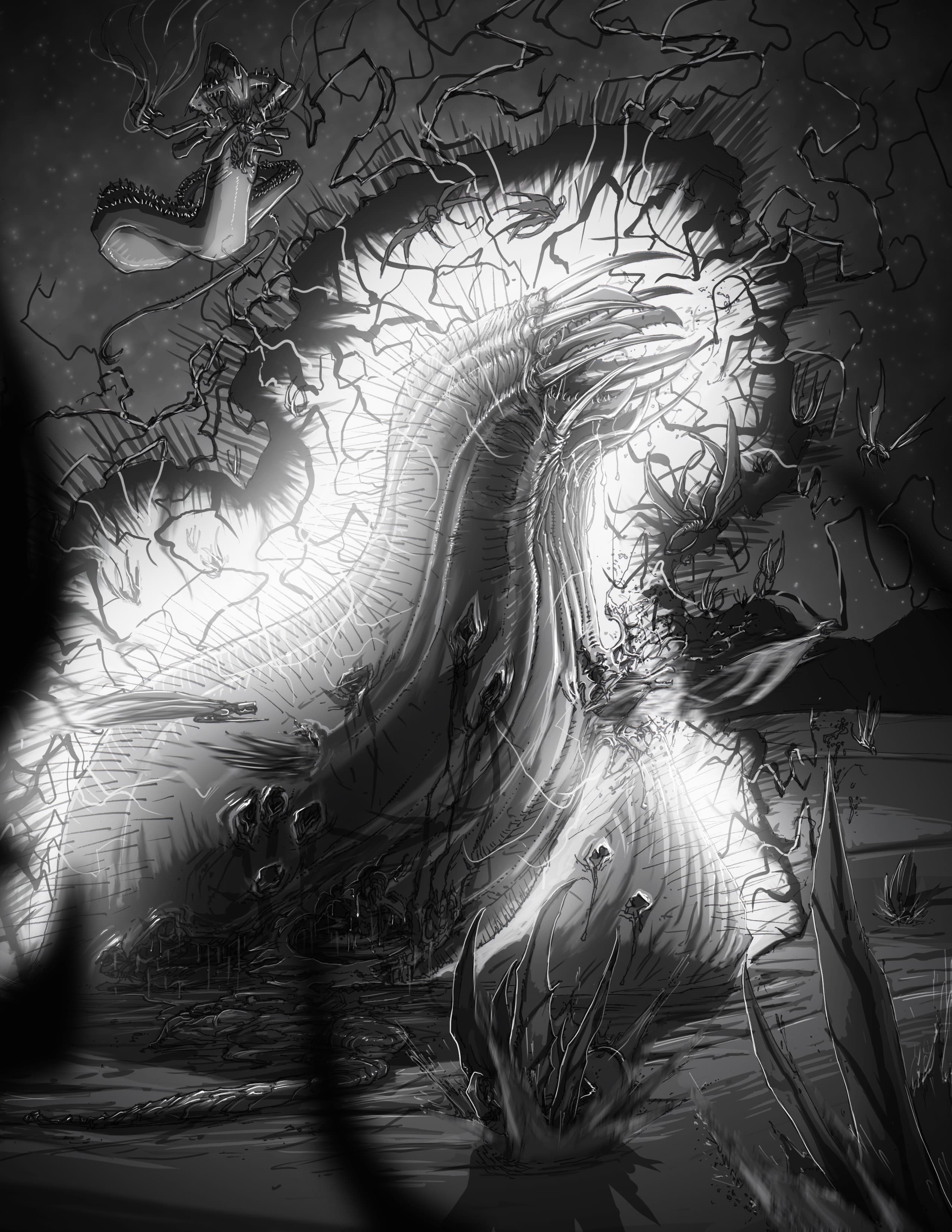
The first major battle of the war unfolds in a symphony of storm and flesh. On one side stands Xerxes, airborne master of the sky, bringing to bear the full fury of his harpies, sleek, swift aerial predators guided by his will and linked by delicate luminescent threads. These threads, marionette strings of pure light, allow engineers to command their broods with fluid precision.
But Xerxes has a secret.
The wings of his harpies do more than lift, they hum, beat, and resonate. When flying in unison, they generate an immense electrical field, creating what has come to be feared as the Black Tempest. The static charge it produces disrupts enemy control, making the threads of rival engineers slippery, unstable, useless. It is by this storm that Xerxes has won battle after battle, tearing through lesser engineers with elegant brutality.
But his opponent is no stranger to this trick.
Icarus does not spread his will thin across a legion. Instead, he places it all within a single creature; a mountainous slug-like colossus known as the Behemoth. This titanic organism lumbers across the Overworld, its back bristling with a forest of needle-like appendages, like a walking graveyard of pikes. It is not fast, but it is unyielding.
Xerxes strikes first, unleashing his tempest. Harpies scream down from the sky, hurling black lightning into the Behemoth’s hide in hopes of tearing it apart.
But the Behemoth does not fall.
Its body is a redundant marvel: multiple hearts, layered kidneys, surplus lungs, and reinforced livers allow it to shrug off damage that would fell any normal creation. It absorbs punishment, plodding forward through the storm.
And then, something changes.
The electrical charge from the Black Tempest doesn’t dissipate. It builds, channeling through the hundreds of needle-like spines across the Behemoth’s back, each one becoming a lightning rod feeding a growing reservoir of power. Icarus, who once fell to this tactic, has turned it against its master.
An opposing storm is born, not of wings, but of wrath. Bolts lance skyward in a deafening crescendo, scattering the harpies like ash in the wind. The sky shatters with light. And for the first time in his reign, Xerxes loses control of the thread. The very strategy that brought him glory has now become his undoing.
It is not just a defeat.
It is a lesson, and Icarus, the Shaper of Shapers, is once again the master of the battlefield.