Gooday everyone,
Welcome to the Deacon Corner. If you’re new here, this space dives into the inspirations behind the images you’ll find throughout the books on these pages. What began as a place to share commission breakdowns has grown into something more. In addition to detailing how each piece came to life, you’ll now find expanded chapter notes, lore entries, and my own black-and-white concept illustrations which are raw glimpses into the ideas that shaped this world before they fully took form.
Before we begin, it’s important to say that none of the beautiful stylized images found in the hard and soft copies of these books would exist without the incredible talent of Sickjoe who is quite literally the heart and soul of this visual world. If you appreciate his work as much as I do, I highly encourage you to visit his gallery and explore more of his creations.
Now, without further ado, let’s take a look at the featured image and learn a bit more about the lore hidden in this chapter.
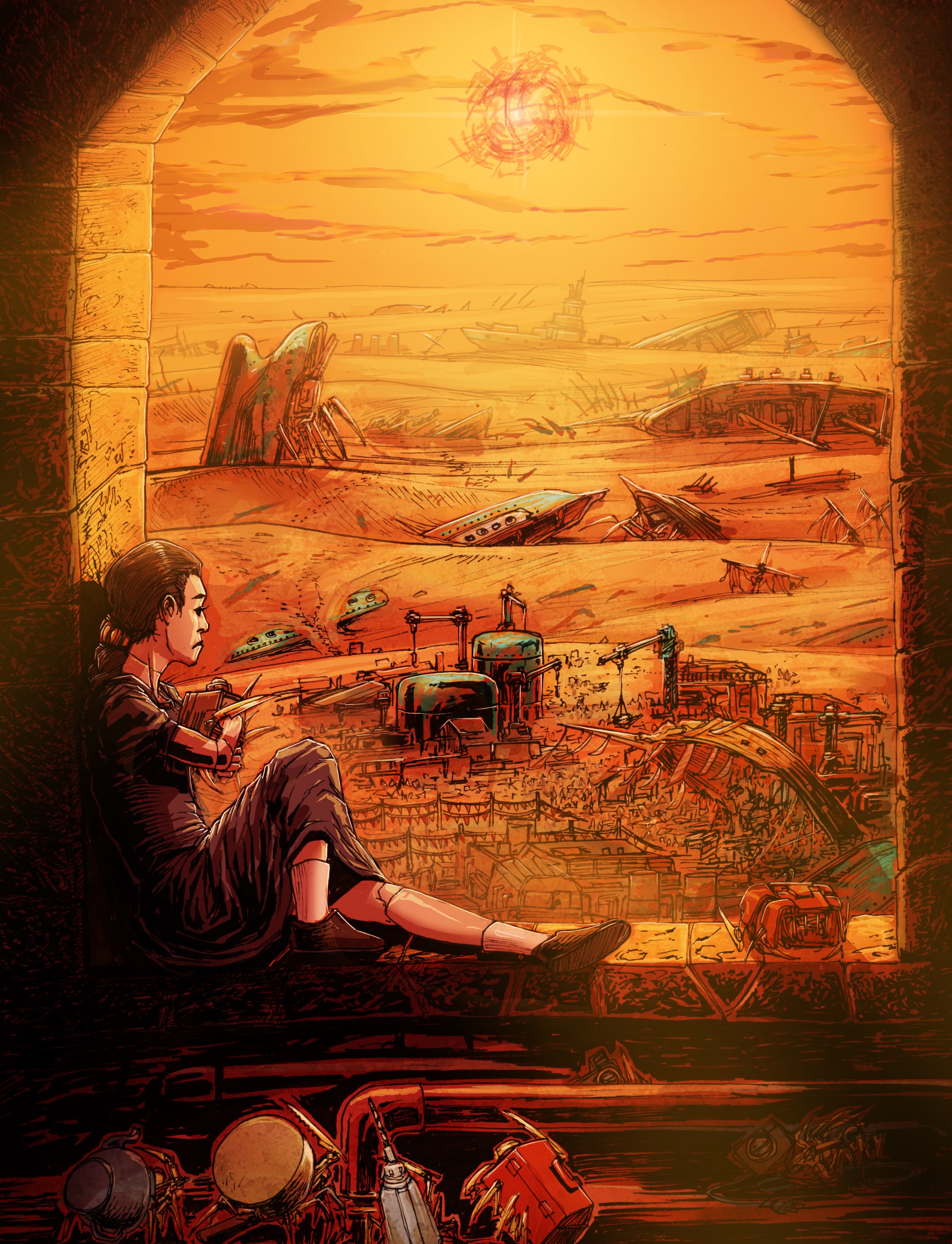
I have a scene in mind with tyke Morta playing in the bell tower of the cathedral. In this scene, we’re overlooking the Oxidized Garden in a way that allows us to get a good view of the strange world the sisters call home.
The Oxidized Garden: This plane of existence used to be a garden world before the immaculate sun was lit. Now it is a sun-scorched hellscape of sandy dunes and sunken ships. The Gnatu call this place home and are as numerous as ants. These machines are skilled at traveling between the plains and are responsible for the ship carcasses that litter the garden. The ships themselves come from every era of humanity, from thousand-foot ore boats to battleships all rusted and damaged, dredged up from their watery graves.
The Gnatu: These guys are the same but in a time before Nona changed them. They are mechanical hermit crabs with camera lenses that vary in size. They use the sunken ships as homes and shelters from the punishing rays of the sun. Some of them are as big as the ships they hide in, trading bows and sterns like crabs trade shells. Their behavior, however, is strangely human. They hang fire-resistant fabrics to dry in the sun like laundry and open strange bazaars where they swap possessions like steel muffin trays and boots. They covet mortal possessions, mechanical fey, wearing outlets and breakers boxes like shells. Where did they get these mortal belongings? Well, if you’ve ever misplaced tools, clothes, or jewelry, these guys are likely involved
One extra thing to note is that, while the Gnatu appear innocent in their behavior, there is something unmistakably sinister about the design of the older models, weapon barrels hidden in their chassis, knives for toes, and crooked spikes for fingers. They were once war tools employed by Iapyx against his brother in much the same way Bastion was.
The Immaculate Sun: The star that illuminates the garden isn’t natural. It was designed as a weapon to end a terrible war by scorching the surface world. It is a mixture of metal and fire, a mechanical star lit before it was fully finished, rebar, and construction cranes, its hull cracked like an egg from the heat and pressure. The instrument is unstable…
Morta: Tyke Morta enjoys watching over the garden from the bell tower of the cathedral. She calls it her crow nest, and it’s where she goes to get away from her sisters. She’s holding a Gnatu tight against her chest like a teddy bear, its many legs squirming to get away from her grasp. The other Gnatu who clean the bell tower behave strangely close to Morta. The sisters emit a code that causes the machines near them to act in a way that pleases them. For Morta, the Gnatu line up like soldiers in formation, saluting her as she passes. The code is short-ranged, however. Ultimately, in this scene, Morta is overlooking the oxidized garden where we can see the unusual bazaar set up in the courtyard beneath her feet to the massive Gnatu in the distance swapping the sterns and bows of rusted ships beneath the watchful gaze of the immaculate sun.
If you’ve made it to the end and found your way here, you’re probably curious about what you just read. I’m glad you are. Let me walk you through these pieces in the author’s notes below which includes some of my original concept artwork:
On the Immaculate Sun
This week, we turn our attention to the Immaculate Sun, a construct often spoken of in the same breath as Iapyx himself.
Long ago, when I first began sketching the foundations of this world, I assembled a series of montages meant to represent the father of fate and fire. Some of you may remember the phrase that accompanied them: “I am the one who brings great change.” It became loosely associated with Iapyx, repeated often enough that it began to feel like truth.
But by now, we know better.
Iapyx is not the avatar of change. He is its opposite existing as an architect of stagnation.
Humanity often mistakes fire for progress. The industrial revolution, the forging of tools, the harnessing of flame, these appear to us as advancements. But to the divine, they represent a different trajectory entirely. Flesh no longer adapts. Where once a creature might grow carapace, hoof, or claw to survive, mortals instead build towers, wagons, and machines. Adaptation is outsourced. Evolution slows. Growth halts.
Fire, in this sense, is not transformation but preservation, and it allows the weak body to endure without changing. It complements the softness of breast and heart that defined Adelaide’s lineage, comfort over adaptation, stability over mutation.

The Immaculate Sun is the ultimate expression of this philosophy.
It burns above the horizon of the Oxidized Garden, radiating such immense heat that organic life cannot take root upon its surface. Nothing grows. Nothing evolves. The Garden has become, effectively, a hive for the Gnatu alone.
One might ask: what of the Sisters of Fate? Are they not partly human? They are but they also carry Iapyx’s blood. Each bears a seal of stagnation, granting near-total dominion over heat. Fire cannot harm them. They refer to this immunity as their father’s blessing. A blessing that, once again, did not fully extend to Decima.
Her immersion in the Sea of Storms stripped away more than the Mangle’s corruption. Without the full protection of Iapyx’s lineage, she cannot walk the burning surface. Instead, she remains within her ship, rarely venturing beyond it. Another quiet consequence of that desperate act of salvation.
So why was the Immaculate Sun created?
By the time the narrative of the Oxidized Garden begins, its purpose has already been fulfilled. The star was built for a single, terrible goal: to end the war that claimed Iapyx’s life. It was a deliberate act of sterilization. Organic life was burned away to ensure that spreading corruption could never return.
A war of attrition ended with extinction and the battlefield was cleansed.
Though its purpose has long since passed, the Immaculate Sun continues to burn. It will do so until the end of time a monument to a war no one living remembers.
It is, in every sense, an artificial star. Its mantle is metallic—constructed from material so resilient that even stellar heat cannot melt it. Plasma erupts from within, vented through towering stacks that puncture its surface. When one peers past the blinding corona, the structure beneath resembles a colossal eye.
That pupil at its center is a black hole forced outward, exposed, disemboweled.
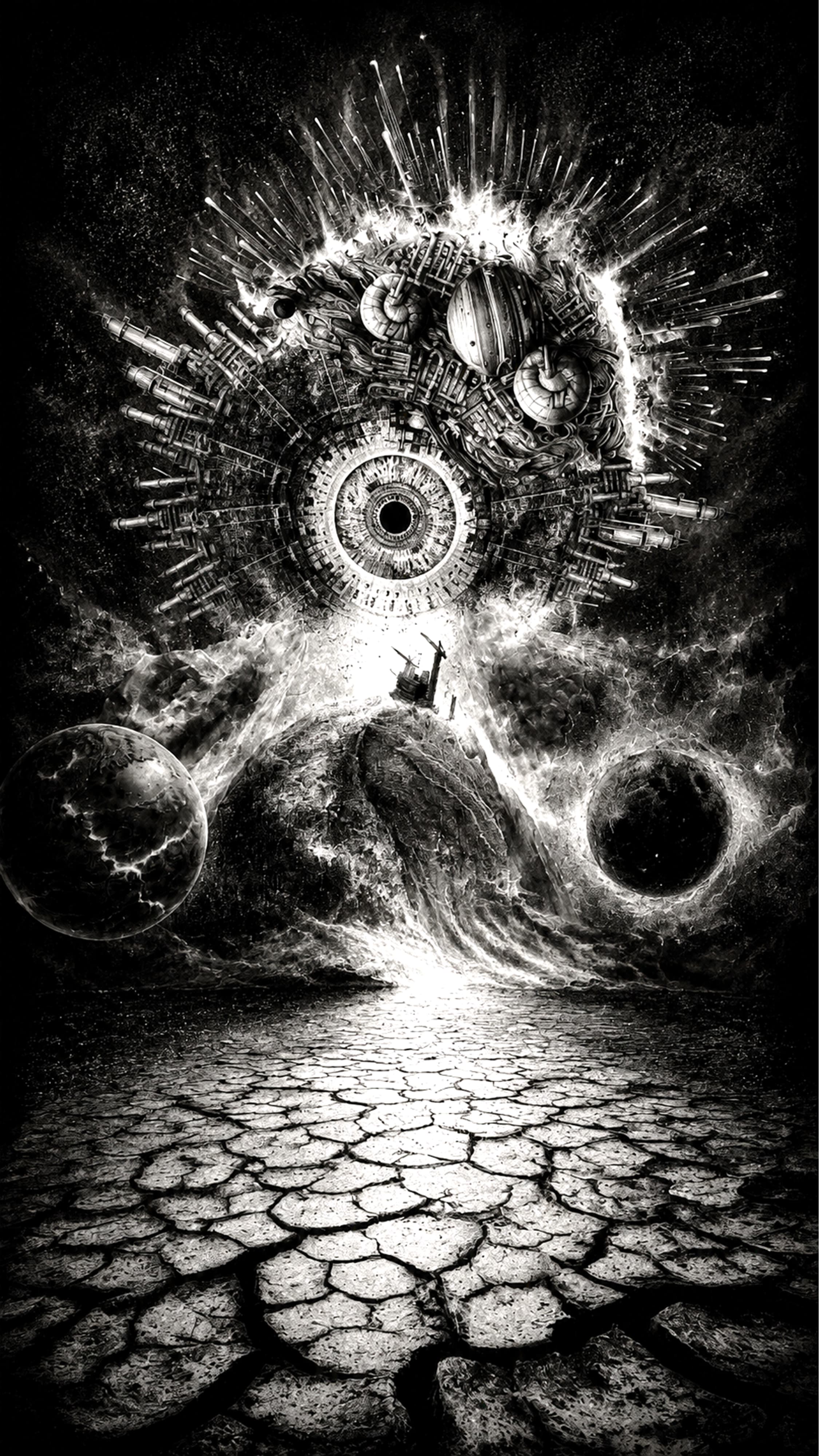
The singularity at its core has been drawn to the surface, its gravity contained within a mantle forged from the petrified remains of a leviathan. Metal adjacent petrification shaped by divine design.
This is the true heart of the hive.
A burning eye of stagnation, watching over a world where nothing new may grow.
On the Nona and Morta's Relationship
In this chapter, we’ve learned a few important things.
First, Nona. She is haunted by nightmares tied to her mother, Madeline. Just as importantly, we discover that Nona is not Adelaide’s daughter, despite what we may have initially assumed. Adelaide, as established in the prologue, is the progenitor of women who bargained with Daedalus for a kiln of her own. She is the mother of Morta and Decima. Nona, however, comes later. The sisters do not share a mother. Nona is something in between. A true half-breed.
And that is why she bleeds.
We also see that Nona has been quietly defying Morta’s authority. She has taken her mother’s tapestry and hidden it away, shielding it from being cut. The question lingers: what becomes of a woman freed from the weave of fate? I’ve offered a few hints here.
What is Madeline on trial for?
This chapter offers a glimpse of the sisters’ power. Nona has authority over fate, metal, fire, and time, and she binds the elements of a wooden mallet into the judge’s tapestry, transforming him into a doll. Remember, her acting father Iapyx was never a lord of flesh but of heavy inorganic materials. Clearly, the sisters' abilities stretch beyond mortal conception, birth, and death.
The act of transmogrification is slow, terrifying, and excruciating. Nona is not a duchess in title alone. Like her sisters, she wields immense power over mortal kind. The message is clear. Threaten her mother at your own peril.
Then there is Morta.
We find her in the bell tower of the Oxidized Garden, and from there we glimpse the sisters’ throne: a vast desert littered with the hulls of sunken vessels. The beautiful ruins of civilizations long dead serve as cushions for the girls’ divinity. By the way, we’re seeing another desert motif here. Didn’t we just learn that dust is often connected to the Great Devourer? Another hint that Iapyx and his daughters are related to that great cosmic windbag.
Through Igor, we learn more about the Gnatu. They were fashioned with a desire to covet as mortals do. The logic is simple: give a soldier something precious, and they will fight harder to protect it. The Gnatu were built for war, and the war itself has been quietly foreshadowed across previous chapters.
Yet the Gnatu function as a kind of mechanical fay. They may take from the human peninsulas, but only what has been discarded. They cannot claim what you cherish. A treasured heirloom is safe. A used handkerchief is not.
Morta, for all her gruffness, reveals her own contradictions. She lingers in the bell tower, but she also secretly plays dress-up. She longs for softness, for beauty… things she believes are incompatible with her station as a dealer of death. What she fails to grasp is that they are not incompatible at all. As Bastion reminds her, she is not meant to be a goddess of death, but of mercy. She simply has not yet grown to fill that mantle.
Finally, we see Morta’s greatest fear: that Nona, because she is a half-breed, may one day have to die.
At first glance, this fear seems at odds with the way Morta bullies her younger sister. But the cruelty is a mask. Morta loves her sisters fiercely, too fiercely to show it plainly. She hides her tenderness behind jeers and pranks. And yet, when night falls and nightmares come, it is Morta who tucks them into bed. Morta who holds them. Morta who promises to protect them, no matter the cost.
That blind sisterly affection is what has damned them all countless times before…