Gooday everyone,
Welcome to the Deacon Corner. If you’re new here, this space dives into the inspirations behind the images you’ll find throughout the books on these pages. What began as a place to share commission breakdowns has grown into something more. In addition to detailing how each piece came to life, you’ll now find expanded chapter notes, lore entries, and my own black-and-white concept illustrations which are raw glimpses into the ideas that shaped this world before they fully took form.
Before we begin, it’s important to say that none of the beautiful stylized images found in the hard and soft copies of these books would exist without the incredible talent of Sickjoe who is quite literally the heart and soul of this visual world. If you appreciate his work as much as I do, I highly encourage you to visit his gallery and explore more of his creations.
Now, without further ado, let’s take a look at the featured image and learn a bit more about the lore hidden in this chapter.
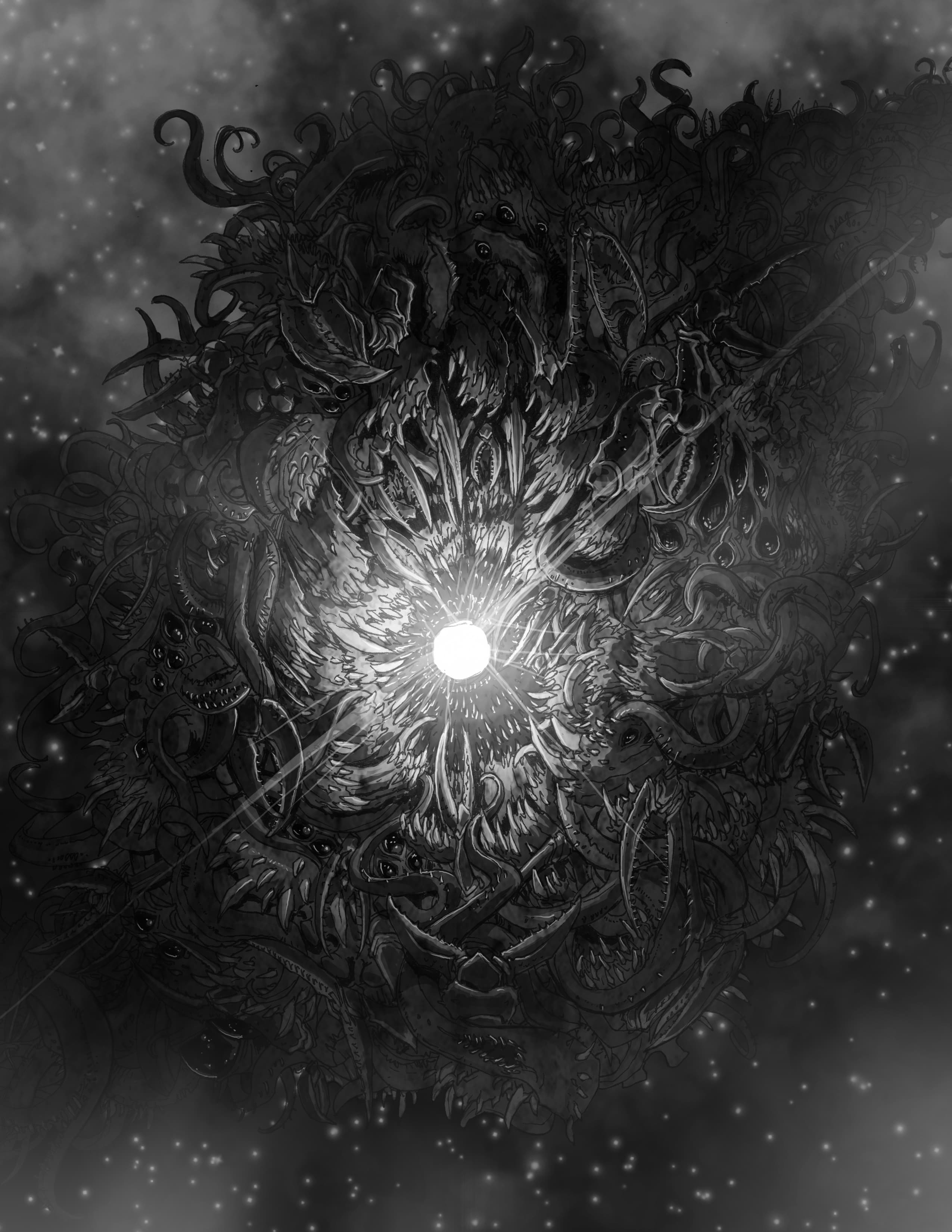
The Great Devourer is among the most ancient and incomprehensible beings of the upper pantheon, an assembly of deities that includes the Basilisk, Iapyx, The Twins, Stormbringer, the Ashen Fog, etc. As with her peers, her form is vast, confusing, and more than a little maddening. She is chaos incarnate, not malevolent, simply mindless, a being whose hunger predates even her own awareness. In truth, the Devourer is an almighty idiot, a cosmic glutton who has forgotten her own name, the only Ouroboros to have done so. A cruel irony, given how obsessively her children cling to the sanctity of names.
She festers at the center of the universe, her body so massive and luminous that even from trillions of light-years away she appears in the peninsula’s night sky as a radiant eye, the heart of the Draco constellation. Worshipped by mortals under the mistaken guise of sainthood, her "divinity" is a distant misunderstood mask. As Dr. Cromwell once lamented, "If you peel back the veils of far-radiance, all you’ll find is a teratoma, a churning mass of eyes, teeth, claw, and coil."
Her body is a living paradox: a womb that births galaxies even as she consumes them. Her movements are a dreamless drift, the steady advance of entropy.
As with all beings of her station, the Devourer is attended by a court. Three greater daemons—Crucius, Crux, and Saevus—serve as her royal tasters and executioners. They are the first to feast upon stars, judging which are worthy to be offered to her insatiable core. They also perform a vital pruning, carving away festering clumps of her own tissue to spawn the lesser leviathans, vast horrors that drift through the dark, serving to slake her nigh endless hunger.
Though known as leviathans themselves, Crucius, Crux, and Saevus serve another: the Basilisk, whose silent will opposes the Great Devourer’s blind appetite. Like the street scholars who strive to blind the lesser leviathans, the daemons perform a cosmic misdirection—guiding the idiot god away from Eden, from the garden, from the truth. Not out of kindness, but necessity.
This final image should depict the Devourer not as a monster in motion, but as a seething, radiant tumor suspended at the universe’s core, its hunger pulling everything slowly, inevitably, inward.
Additional Lore Bits
Another detail easily overlooked is that Kath’le Kal, the engineers’ realm, lies within the Devourer’s own belly. In practical terms, anything she consumes is cast into that internal battleground, where alien warriors clash without end. Most who fall there are ground down to little more than sand.
By the way, you’ve almost certainly heard these leviathans speak before. Crucius, Crux, and Saevus are none other than the demonic poets whose voices whisper through every deacon tale. And while we’re on that subject, you may have noticed the small symbols that appear above many of my chapters and stories. These marks denote the members of the pantheon most deeply woven into the tale.
Now, those familiar with chess will recall that every major piece has a pawn bound to it. The pantheon follows the same structure. The queen, whom we recognize as the Devourer, claims the engineers as her pawns. Iapyx’s pawns are the Sisters of Fate. Yet the deacon pawn does not answer to the queen but instead to the missing king. As discussed earlier, Crucius, Crux, and Saevus serve the Basilisk, despite performing a crucial pruning rite on behalf of both the queen and one of the bishops, Millia Gnu Aye.
Each major book in this series will reveal one of these divine chess pieces, slowly completing the set and filling in the blanks of the pantheon.
As always, big thanks to SickJoe who is behind the design of these astral pieces.
I've given a few spoilers here, but any guesses as to who fill in the other blanks? As a general rule, demigods or lesser members of the pantheon tend to fill the pawn roles, but that doesn't make them any less dangerous. As the homepage states: Among the astral pieces, strategy reigns, for even a pawn may yet unseat a queen.
And before I leave you, you may have heard me use the name Triginta Duae, the formal title for this warped family of gods and goddesses. Triginta Duae is Latin for Thirty-Two.
How many pieces rest on a chessboard again?
And we haven't even touched on the other side of the board...