Gooday everyone,
Welcome to the Deacon Corner. If you’re new here, this space dives into the inspirations behind the images you’ll find throughout the books on these pages. What began as a place to share commission breakdowns has grown into something more. In addition to detailing how each piece came to life, you’ll now find expanded chapter notes, lore entries, and my own black-and-white concept illustrations which are raw glimpses into the ideas that shaped this world before they fully took form.
Before we begin, it’s important to say that none of the beautiful stylized images found in the hard and soft copies of these books would exist without the incredible talent of Sickjoe who is quite literally the heart and soul of this visual world. If you appreciate his work as much as I do, I highly encourage you to visit his gallery and explore more of his creations.
Now, without further ado, let’s take a look at the featured image and learn a bit more about the lore hidden in this chapter.
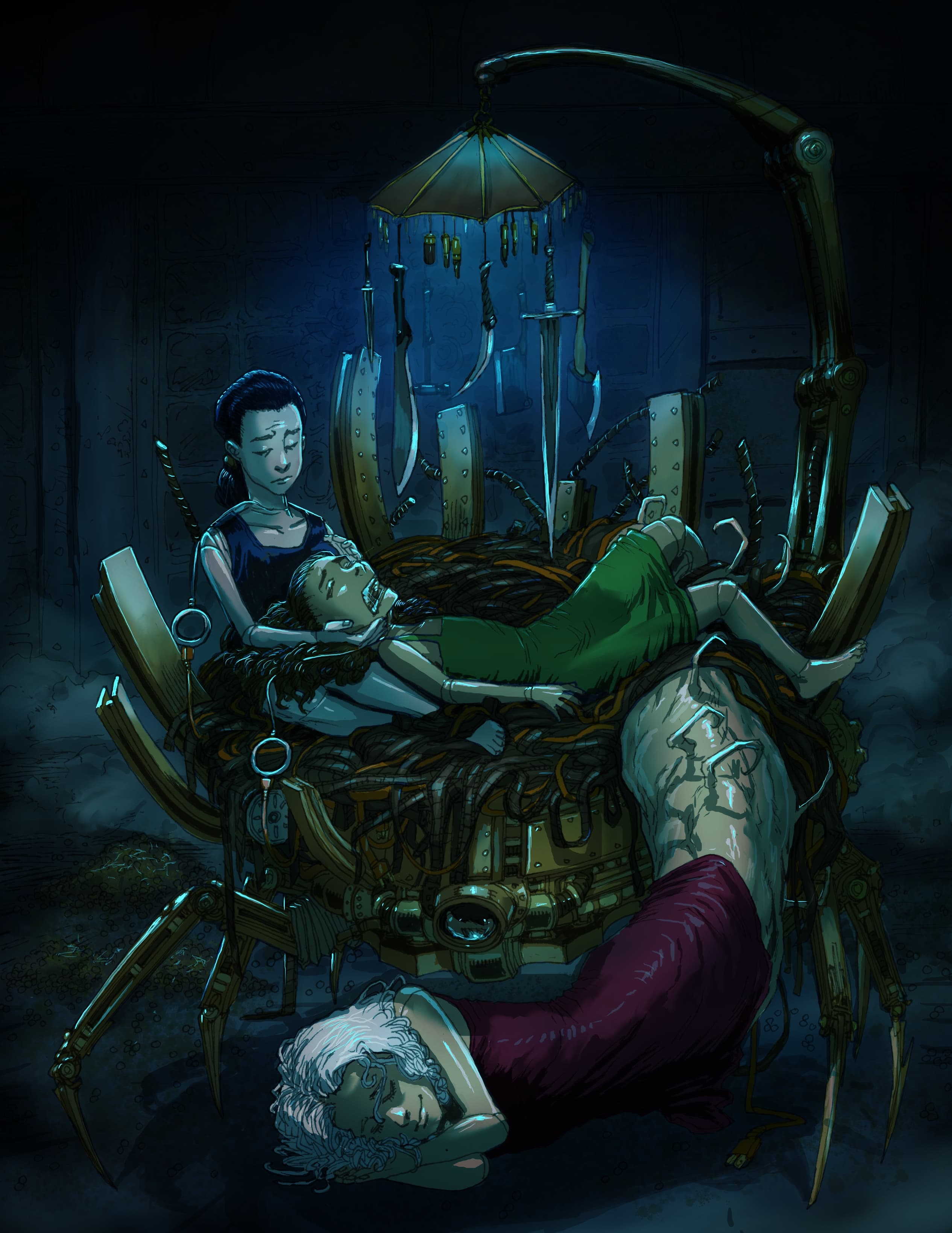
I’ll need a piece focusing on the tykes and the metal crib.
I have a scene in mind involving the sleep habits of our fate-weaving trio when they were children under Bastion’s care. They shared a room and a most unusual bed.
Metal crib: Imagine a cradle made from jumper cables, beams, film reels, and metal cogs. The girls were raised on a sentient mattress, their sheets made from exposed wire and unrolled Kodak film. The cradle is alive, a repurposed Gnatu, its camera lens peaking out beneath the mattress, literal claw-footed furniture. It has a tail that curves up and over the mattress, becoming one of those crib chandeliers. You know those things that are often hung above cradles with shapes, stars, and ponies? Yeah, well, Morta’s not a fan of shapes, stars, and ponies and has strung claymore’s, knives, and .308 rounds as decoration instead.
In general, think of the tub from The Nightmare Before Christmas, and you get the idea. It’s an oversized crib for three that no sane parent would ever be comfortable leaving their children in, but to the sisters of fate, it’s just another Monday.
Nona: Tyke Nona struggles with nightmares. She dreams that her mother is in danger and often cries out in distress. While she sleeps, a doll string hangs from the back of her neck, which is connected to one of the extension cords that make up the sheets. The sisters draw power through a stable trickle charge and Nona is always screwing up, picking the wrong connection, and suffering from sudden amp overloads. The poor child is in pain, she cries in her sleep, but she is not alone…
Decima: Tyke Decima is the textbook definition of a restless sleeper. She rolls all over the place; in fact, she’s fallen out of the crib entirely, her body wrapped in undeveloped Kodak film and exposed wire. Her serpentine calves remain sprawled across the foot of the mattress, and she wears a grin from ear to ear as she sleeps. Whatever dream that girl is having probably involves a seasoned summer roast with a glaze drizzled cinnamon roll…
Morta: Tyke Morta is the caretaker here. Despite being nearly the same age, she often acts as a mother to her sisters. In this scene, she lies next to Nona, cradling her, and whispering in her ear that it’ll be alright and that she isn’t alone. Like Nona, a doll string hangs from her neck and connects with the cradle. Morta forgoes her comfort, staying up late until her little sister finds peace. That often means Morta doesn’t get any sleep at all… She may be a gruff tomboy, but in secret, she loves her sisters dearly.
Background: How should I put this one… A guest bedroom in a steampunk doll house, pipes, taconite, and a drop of lead poisoning? In all seriousness, the background isn’t as important here as most of the focus should be on the sisters and their unusual crib.
If you’ve made it to the end and found your way here, you’re probably curious about what you just read. I’m glad you are. Let me walk you through these pieces in the author’s notes below which includes some of my original concept artwork:
On the Gnatu
This week, we turn our attention to the small machines that keep the Oxidized Garden running.
The Gnatu.
If you have followed the sisters for any length of time, you have already seen them, skittering around in scenes, tending, watching, and collecting. I often describe them as drones of an iron hive, and that description is not far from the truth.
The Gnatu were created by Iapyx long before Adelaide and her daughters. In their earliest form, they were not the curious, almost endearing creatures we encounter now. They were forged of iron, anvil, and hammer—handmaidens of permanence. Their purpose was simple: to hold things in place. To nail the remnants of fate down and keep them from drifting.
They were caretakers of stagnation.
To understand why they exist, we must again consider the divide between the two brothers.
Daedalus embodies change. Flesh, growth, adaptation—his domain is fluid and restless. Iapyx, by contrast, governs permanence. Metal, once shaped, resists alteration. It endures. Where Daedalus builds a world in motion, Iapyx seeks to fix it in place.
And beyond even that, Iapyx rules over the unseen: fate, time, and space.
These are the forces mortals cannot grasp, and yet they define everything. Through them, Iapyx attempts to impose a vision of stillness upon a universe that refuses to remain still. He would repaint existence again and again until permanence is achieved.
But permanence cannot be maintained alone.
The Gnatu were his solution.
Endless workers, forever adjusting the hands of time back toward the twelfth hour. The earliest generations were little more than living paperweights, constructs designed to keep reality from slipping forward. But the effort was doomed from the start. Change is not so easily denied.
Daedalus’s influence proved stronger.
When Iapyx looked into the weave of his own fate, he saw his end—his brother’s hand closing around his throat. In defiance, he struck first.
What followed reshaped everything.
Adelaide’s kiln was poisoned. The Mangle spread through her children. War broke across the Garden. The Gnatu, once servants of stillness, were reforged as soldiers to defend Iapyx’s dominion.
It was not enough.
Iapyx fell. The war ended. And the Garden was left in the care of his daughters, Morta, Decima, and Nona, alongside Bastion.
The Gnatu endured.
Even now, they carry the memory of that war in their design. Beneath their curious behaviors lie weapons: bladed limbs, loaded barrels, and implements that no longer serve their original purpose. They linger like vestigial organs, remnants of a more violent age.
Yet the most curious thing about the Gnatu is not what they were.
It is what they become.
The sisters do not consciously command them, but they do not need to. Each emits something akin to a signal—a frequency carried in Iapyx’s bloodline. The Gnatu respond instinctively, aligning themselves to the desires of whichever sister they serve.
Nona longs for a child, and so the Gnatu become children, playful, eager, attentive.
Morta prepares for war, and they fall into ranks assembling engines of siege, launching taconite from trebuchets, ever ready for battle.
Decima seeks love, and they offer her companionship, awkward, earnest proposals of marriage from creatures that barely understand the words they speak.
The sisters are not queens in title, but in function. Each acts as a kind of living transmission tower, broadcasting intent into the hive.
The Gnatu simply answer.
They are what they are needed to be, just as they once were for Iapyx.
But they possess other peculiarities.
They covet material possessions.
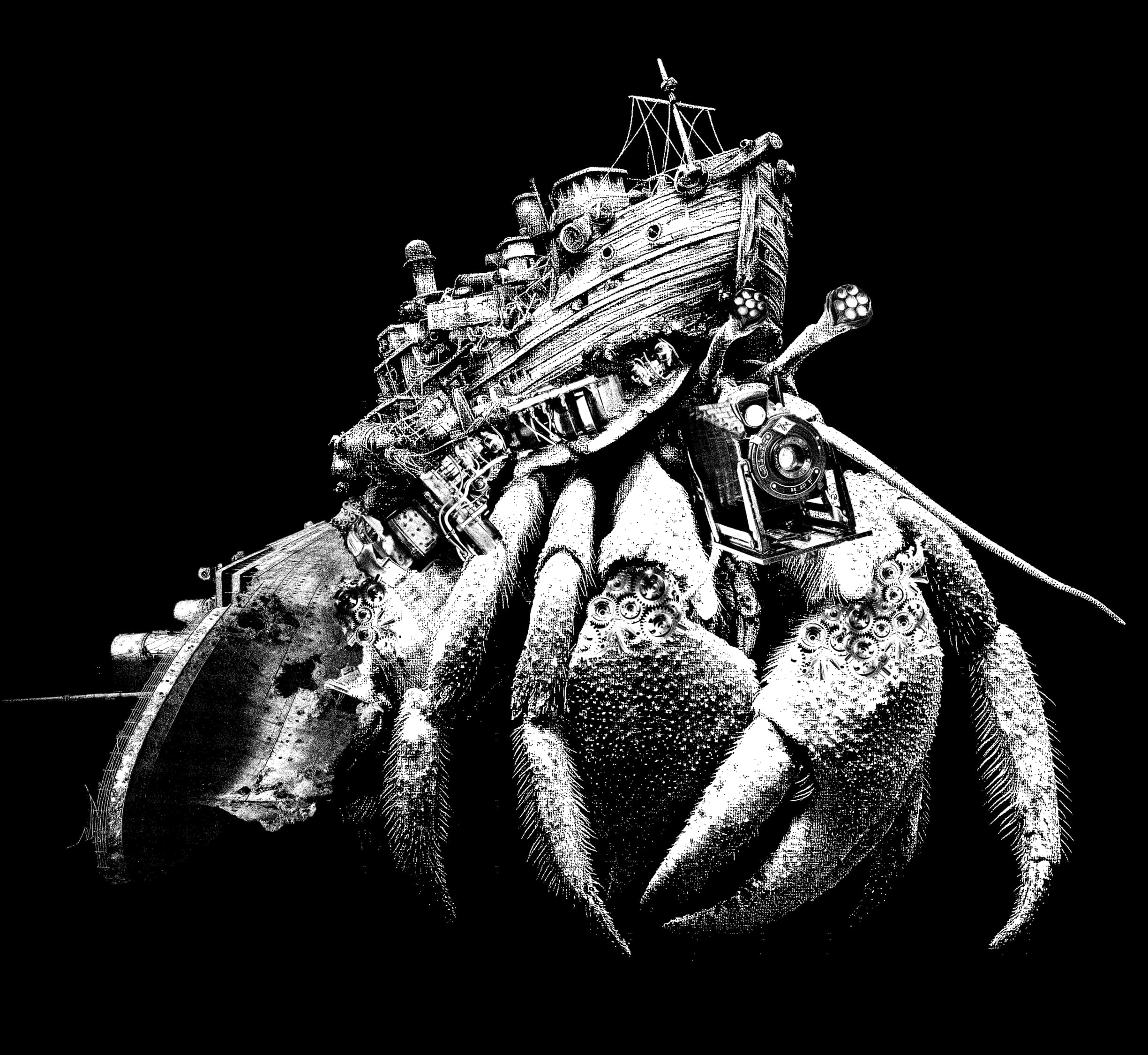
Like hermit crabs, they gather and exchange material objects: breaker boxes, bus bars, toolkits, computer towers, and discarded televisions. These items are scavenged from the drifting peninsulas, remnants of countless eras, which is why the Garden is littered with a strange fusion of archaic and modern technology.
And yet, they are bound by rules.
The Gnatu may only take what has been discarded. Nothing cherished. Nothing claimed. Like mechanical fae, they adhere to a strict and unbreakable code. Ownership, once relinquished, becomes an invitation.
This behavior is not incidental. It was designed.
Iapyx understood a fundamental truth: beings, whether flesh or metal, fight harder when they have something to lose. By teaching the Gnatu to collect, to value, to want, he gave them a reason to defend what they held.
Even now, that instinct remains.
The Gnatu vary wildly in form. Some are as small as rodents, others as large as homes. The largest among them perform rituals reminiscent of hermit crabs, exchanging entire vessels—sunken ships repurposed as shells. They line up in descending size, each taking the place of the one before it, until all have found a better fit.
An ordered exchange.
They are most often described as arachnid, many-limbed, mechanical, with camera lenses for faces. They watch. They gather. They wait.
Drones of an ancient hive that no longer has a king.
And yet, they remain.
Faithful not to what was, but to what is needed now.
And we still have much to uncover about them, but we’ll save that for another chapter.
On Peninsulas
By now, you have likely heard the term peninsula more than once. It is time to clarify what that means within this plainscape.
We have already explored the violent union between the Great Devourer and Beren Gal, the event that birthed the Sea of Storms, the Primordial Kiln, and the twin deities Iapyx and Daedalus. But that collision did not end with gods and leviathans.
It also created worlds.
These worlds, planetary bodies formed from divine violence, are what we call peninsulas. The distinction matters. They are not natural planets shaped by slow cosmic processes, but fragments of a catastrophic union, each carrying the imprint of its origin.
As such, they are unstable, or perhaps more accurately, experimental.
Each peninsula operates under its own set of rules, often diverging wildly from what we would consider natural law. Some are cultivated as controlled environments by the upper pantheon: test groups shaped, observed, and, at times, discarded. The Basilisk maintains its control groups. Millia Gnu Aye’s stillborn children drift as malformed worlds, their surfaces echoing failed creation.
No two peninsulas are truly alike.
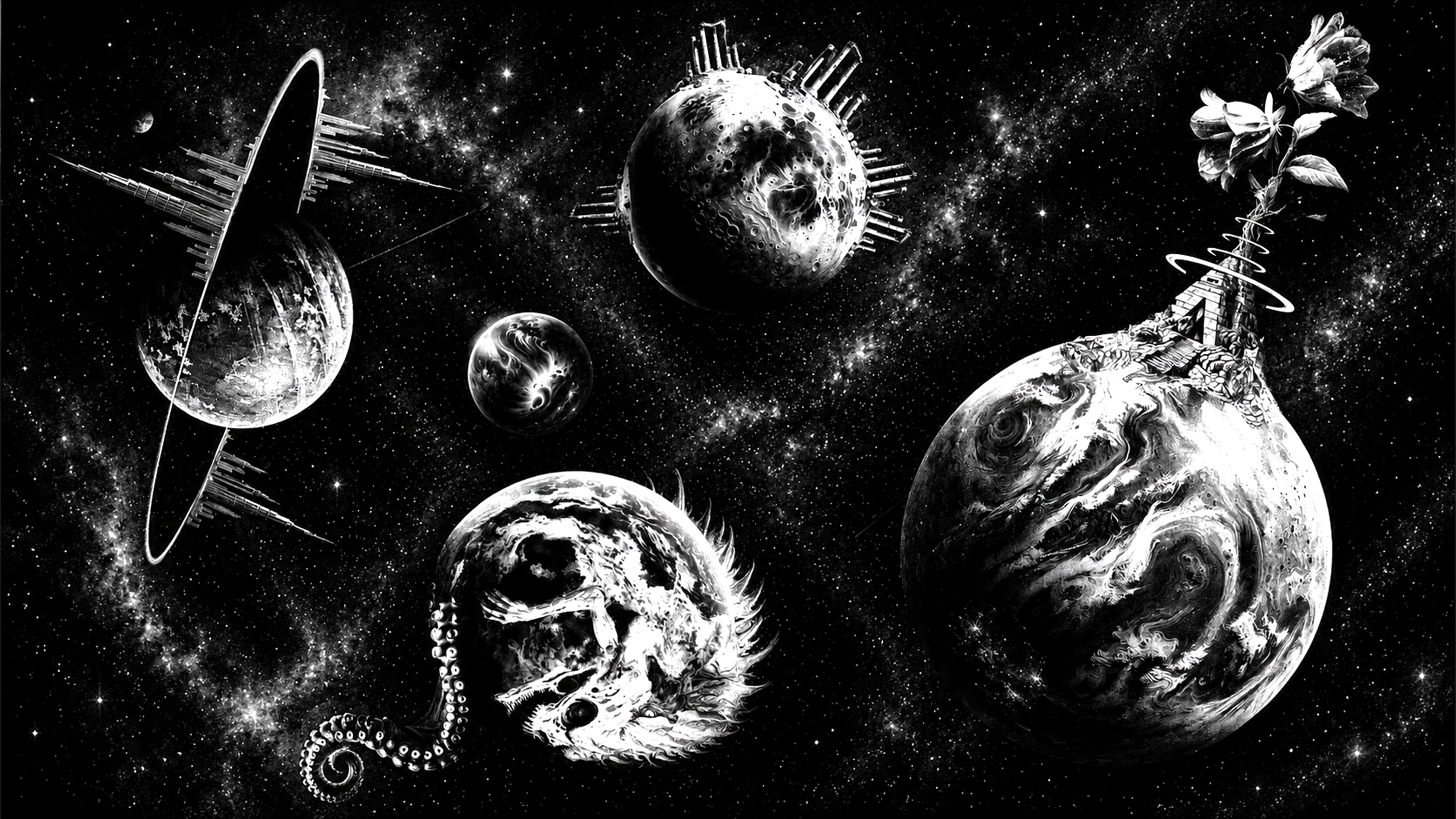
Some develop intricate systems of magic. Others ascend technologically to impossible heights. Still others exist in bizarre states where logic itself bends, worlds where cities cling to planetary rings while the surface below is claimed by a hungry god, or where entire civilizations survive within the husk of something that was never meant to live.
The stillborn worlds of Millia Gnu Aye are perhaps the most unsettling. These peninsulas resemble malformed embryos, their inhabitants scavenging what little they can while hiding from the cannibalistic horrors that roam their streets.
And yet, across all of them, one constant remains: they are seeded with mankind.
Humanity is placed upon these worlds and allowed to grow, adapt, and fracture under wildly different conditions. The vast distances between peninsulas serve a purpose. Isolation ensures the integrity of the experiment. Civilizations rarely, if ever, interact. A handful of spacefaring colonies exist, but they are the exception.
For the most part, each world suffers and evolves alone, and only the deities move freely between them.
We have already seen this in practice. Nona slips between peninsulas and timelines alike, hiding her mother from Morta’s reach. For beings tied to fate, space and time are not barriers.
There is, however, one notable exception to this isolation. Sebala.

A dreamscape unlike any other, Sebala allows peninsulas to exist in close proximity. Its ruling duke, an entity I have depicted before, binds multiple worlds in chains, drawing them near his own flesh. Here, inhabitants from different peninsulas may meet, trade, and influence one another.
It is an anomaly. A deliberate violation of the rules. Sebala exists through the indulgence of a greater force, the Cosmic Ark, which gathers peninsulas like marbles, arranging them for its own obscure and unsettling purposes. What is experimented elsewhere becomes a spectacle here.
And beyond it all, the truth remains unchanged. The peninsulas were born from the Devourer. And to her, they will return. The Leviathans drift endlessly through the abyss, seeking these wayward worlds. When they find them, they consume them, folding matter, memory, and life back into the flesh from which they were first torn.
In the end, every peninsula is temporary. A fragment of violence, given time to bloom before it is swallowed whole.