Gooday everyone,
Welcome to the Deacon Corner. If you’re new here, this space dives into the inspirations behind the images you’ll find throughout the books on these pages. What began as a place to share commission breakdowns has grown into something more. In addition to detailing how each piece came to life, you’ll now find expanded chapter notes, lore entries, and my own black-and-white concept illustrations which are raw glimpses into the ideas that shaped this world before they fully took form.
Before we begin, it’s important to say that none of the beautiful stylized images found in the hard and soft copies of these books would exist without the incredible talent of Sickjoe who is quite literally the heart and soul of this visual world. If you appreciate his work as much as I do, I highly encourage you to visit his gallery and explore more of his creations.
Now, without further ado, let’s take a look at the featured image and learn a bit more about the lore hidden in this chapter.
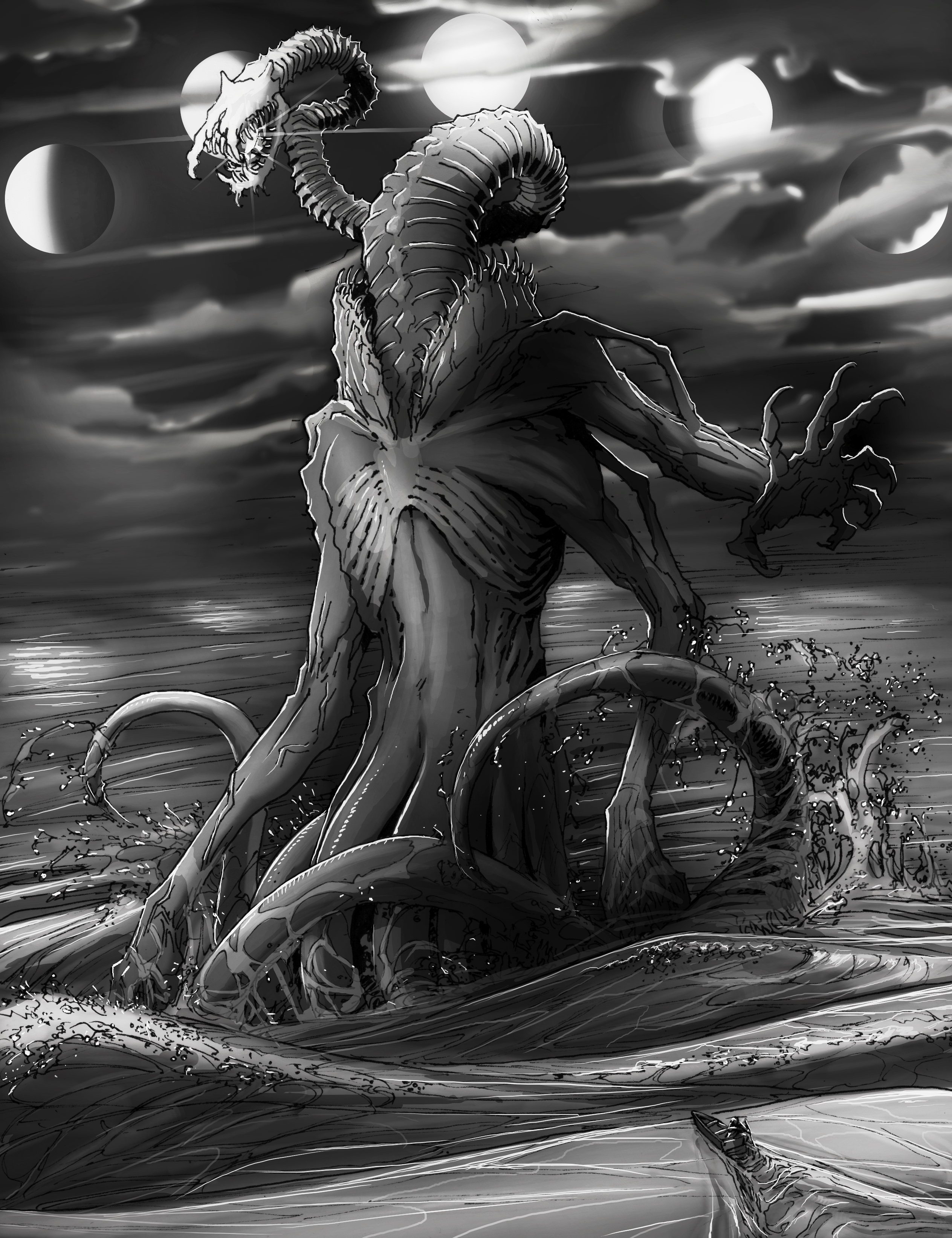
For this month’s piece, I’d like to tackle a surreal, abstract cosmic horror: The Basilisk. It is the patron deity of the Court of Nine Lives and one of the most powerful of the ascended outer gods.
The Basilisk draws heavy inspiration from Lovecraft’s Nyarlathotep, particularly in its fluid, ever-mutating anatomy and its sense of impossible presence. This is not a creature meant to be understood, only witnessed briefly, and at great cost.
Manifestation & Symbolism
To mortals, the Basilisk often appears as something deceptively simple: an eyeless white cat. Visually, I always associate this form with multiple moons shown simultaneously in various phases of waxing and waning.
These overlapping lunar phases are a key motif. They represent a distortion of spacetime—where the Basilisk walks, the past, present, and future bleed into one another. As a result, the environment surrounding it should feel warped, unstable, and subtly wrong, even before its true form is revealed.
Scene Concept
The scene follows a young man stranded at sea, alone in a small fishing boat: he witnesses the Basilisk emerging from a violently roiling ocean.
The scale contrast is important here, as the fragility of the boat contrasts with the immense mass of the entity. The sea itself should feel disturbed, as if reality is buckling under the Basilisk’s ascent.
True Form of the Basilisk
In this piece, the Basilisk appears in its true form, which bears no resemblance to the cat beyond lingering fragments. The entity is suspended above the ocean, supported by tentacle-like appendages rather than legs. It possesses multiple arms branching asymmetrically, creating a layered, almost recursive anatomy. Its head is elongated and whip-like, similar in spirit to classic Nyarlathotep depictions.
At the end of this whip-like appendage is the last vestige of the cat: A mouth split impossibly wide, revealing an oval cross-section of exposed tissue. Embedded at the center is a jewel-like organ—the Basilisk’s third eye. This eye is the true horror of the piece: anyone who gazes upon it is transmuted into pure glass.
Environment & Composition
The Basilisk should rise from the ocean like a colossal iceberg, its scale so vast it displaces the sea itself. The water should surge and tilt violently, nearly capsizing the fishing vessel. Above the entity, every phase of the moon arcs across the sky in a sweeping band, reinforcing the idea of temporal overlap and cosmic imbalance.
Additional Lore Bits
The Basilisk, also known as the Wraith Deity, was the first of these gods I truly developed for the expanded compendium. His origins stretch all the way back to my childhood as a ’90s kid, raised on Toonami and late-night cartoons. Believe it or not, I was developing the Lovecraftian cat long before the whole Garfield-Cthulhu crossover ever became a thing. I like to joke that I’m owed royalty checks, but in truth, I was simply too slow to the punch.
The eyeless cat goes by several names, which I tend to use interchangeably, and his presence, subtle or otherwise, is woven throughout many of my works. He is the hidden architect behind the Deacons, Crusius, Crux, and Saevus, the progenitor of the dreaded interplanetary parasites known as the Whiskers, and the ruling patron of the Court of Nine Lives. He is often called the All-Father, for he is the eldest of the deities, with no true beginning and no conceivable end.
It is said that where once he coveted stone, now he sees only glass. But what does that actually mean?
Each deity of the Upper Pantheon is bound to a state of being or a fundamental form of matter. By now, we should be well acquainted with the Great Devourer. She is the mother of entropy, and her domain, the Plains of Kath’le Kal, is a vast desert of pale, white sands. As Queen of the Trigintia Duae, she is intrinsically tied to dust: the simplest form of matter, and the inevitable destination of all existence.
By her mere existence, entropy was baked into reality itself. All natural law bends around her distortion, and much like Azathoth’s dreaming, if the Devourer were ever to vanish, reality would either cease entirely—or persist in a warped, unrecognizable state.
So then, what of the Basilisk?
We know that when this god was whole, he valued stone: unmoving, immutable, eternal. He adorned himself in rings of quartz and bound himself in perfect stillness. But at some point, the Basilisk beheld a place known only as the Garden of Eden. For reasons I’ll be keeping to myself for now, he could not enter it. He desired its perfection so desperately that the longing became unbearable.
To free himself from that pain, the Basilisk tore out his own stomach.
That severed organ became the Great Devourer.
In doing so, the Basilisk became the origin of the most destructive force in this reality. And after excising that piece of himself, his values shifted. Stone was abandoned. Glass, fragile, ordered, and cruelly precise, became his new obsession. He cast aside the Whiskers and established an eternal court of ice and tempered prisms.
The Whiskers, however, persist.
These interplanetary parasites drift through the cosmos, infecting stars with their corrupting presence. Any star under their influence emits a terrible bluish-white light that petrifies all it touches, reducing matter to pure stone. They are a class of leviathan born of the Basilisk himself—distinct from the cosmic jellyfish tied to the Devourer, or the human leviathans birthed by Millia Gnu Aye.
As one might expect, the Whiskers continue to enact the Basilisk’s ancient will from the time he was whole. They have rejected his new dominion of glass, carving for themselves an empire rooted in the old dynasty of unmoving stone. The greatest among them are Ushaka Mecchi and Nu Geb, though those parasitic daemon-sultans are tales for another time.
As for the Basilisk’s appearance, he manifests in several monstrous forms. The one depicted here is lesser-known and closer to his primordial state. Nyarlathotep was a heavy influence in shaping this design. While many are familiar with the Basilisk’s more subdued incarnation, an eyeless white cat, he also possesses a far more twisted, bestial form… one not yet fully revealed.
If you look closely at the design, you’ll notice that the only remnant of the cat is the whip-like appendage emerging from the neck. The jaw is split impossibly wide, exposing an oval cross-section of living tissue. The jewel suspended within is a third eye, and like the Whiskers before it, its gaze can transmute any observer into pure glass.
Glass, after all, is merely sand brought into order, superheated, compressed, and forced into structure. This metaphysical relationship hints at a deep connection between the Basilisk and the Devourer. Even the Deacons, the Basilisk’s new servant Leviathans, remain close to both the Queen and the First Bishop of the Trigintia Duae, suggesting that he continues to watch his severed offspring with great interest.