Gooday everyone,
Welcome to the Deacon Corner. If you’re new here, this space dives into the inspirations behind the images you’ll find throughout the books on these pages. What began as a place to share commission breakdowns has grown into something more. In addition to detailing how each piece came to life, you’ll now find expanded chapter notes, lore entries, and my own black-and-white concept illustrations which are raw glimpses into the ideas that shaped this world before they fully took form.
Before we begin, it’s important to say that none of the beautiful stylized images found in the hard and soft copies of these books would exist without the incredible talent of Sickjoe who is quite literally the heart and soul of this visual world. If you appreciate his work as much as I do, I highly encourage you to visit his gallery and explore more of his creations.
Now, without further ado, let’s take a look at the featured image and learn a bit more about the lore hidden in this chapter.
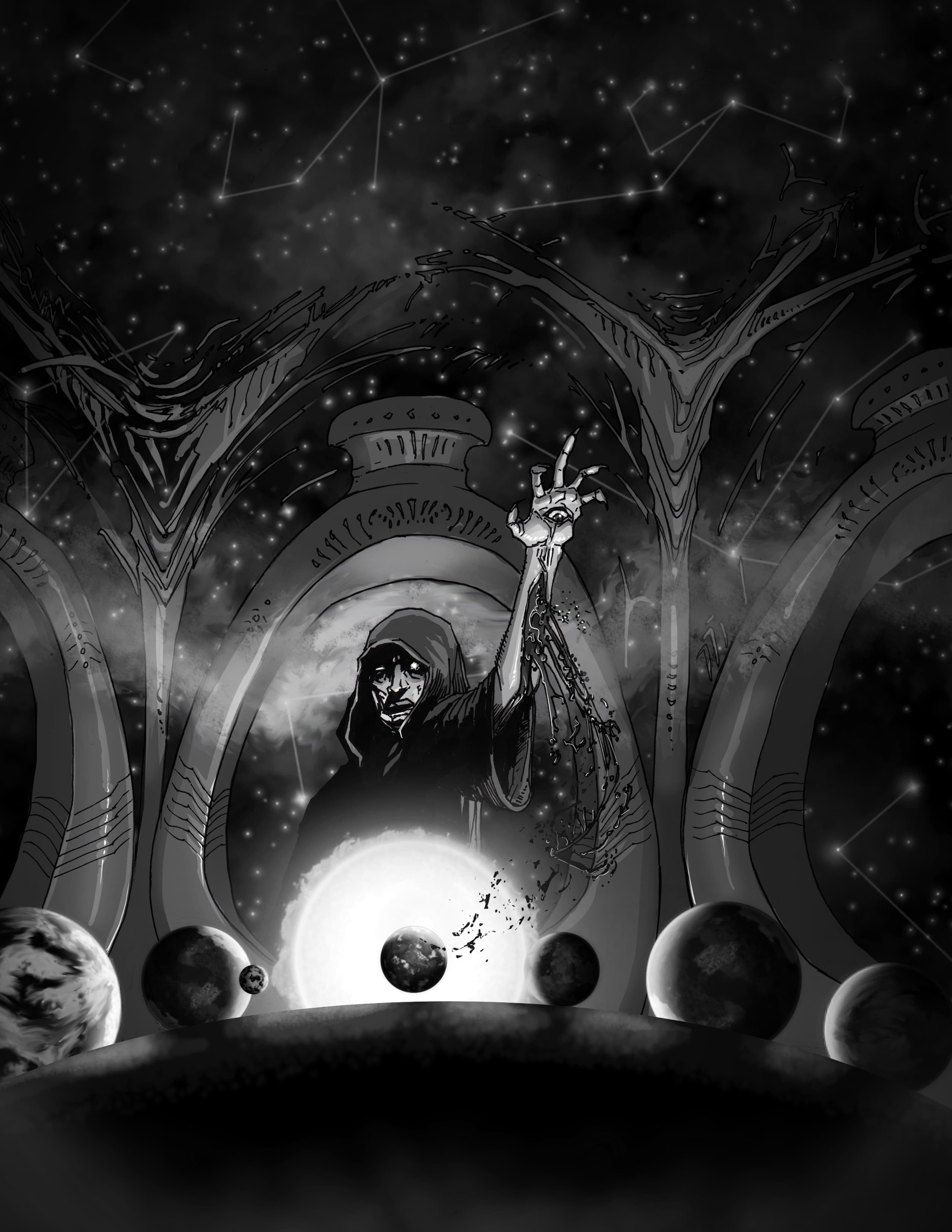
Nestled in the throat of the Great Gorge, stands the Astralarium—a temple built from the stapes bone of a leviathan, the smallest bone in a human ear, yet, for these cosmic beasts, impossibly vast. The structure hums with resonance, amplifying the attunement of the scholars to the distant, star-swimming beasts they serve.
At its heart lies the Sundial, an instrument that is not a timekeeper, but a celestial engine. This monumental orrery occupies the center of a vast, amphitheater-like chamber. A radiant globe at its core burns with artificial sunlight, illuminating twelve great silver rings that arc and spin around, each one an orbital path for the twelve planets in the peninsula’s solar system.
Of these twelve, six are gas giants, and they hold special significance: Juno, Bacchus, Demeter, Fortuna, Janus, and Vesta. These colossal bodies are essential in evading the everwatchful gaze of the devourer. By manipulating their orbital paths, scholars can bend light, gravity, and perception to conceal the world—hiding the peninsula from the terrible eyes of the Leviathans forever starved and searching for life.
Above the sundial, the ceiling glimmers with artificial starlight depicting the major constellations. Each constellation represents a prison, a celestial tomb where a leviathan writhes unseen, watching, and waiting. It is a map of cosmic captivity.
The sundial, intricate and alive with shifting rings and whirring gears, is a tool that can only be operated by those attuned to the very creatures it hides the world from, resistant to their whispers and the coming madness.
And so the peninsula’s survival rests in the hands of its cannibalistic scholars, their sanity threadbare, their purpose terrible. The sundial is both their charge and their curse. Should they fail, even for a moment, the veil will lift, and the Leviathans will see.
And when they see, they feed.