Gooday everyone,
Welcome to the Deacon Corner. If you’re new here, this space dives into the inspirations behind the images you’ll find throughout the books on these pages. What began as a place to share commission breakdowns has grown into something more. In addition to detailing how each piece came to life, you’ll now find expanded chapter notes, lore entries, and my own black-and-white concept illustrations which are raw glimpses into the ideas that shaped this world before they fully took form.
Before we begin, it’s important to say that none of the beautiful stylized images found in the hard and soft copies of these books would exist without the incredible talent of Sickjoe who is quite literally the heart and soul of this visual world. If you appreciate his work as much as I do, I highly encourage you to visit his gallery and explore more of his creations.
Now, without further ado, let’s take a look at the featured image and learn a bit more about the lore hidden in this chapter.
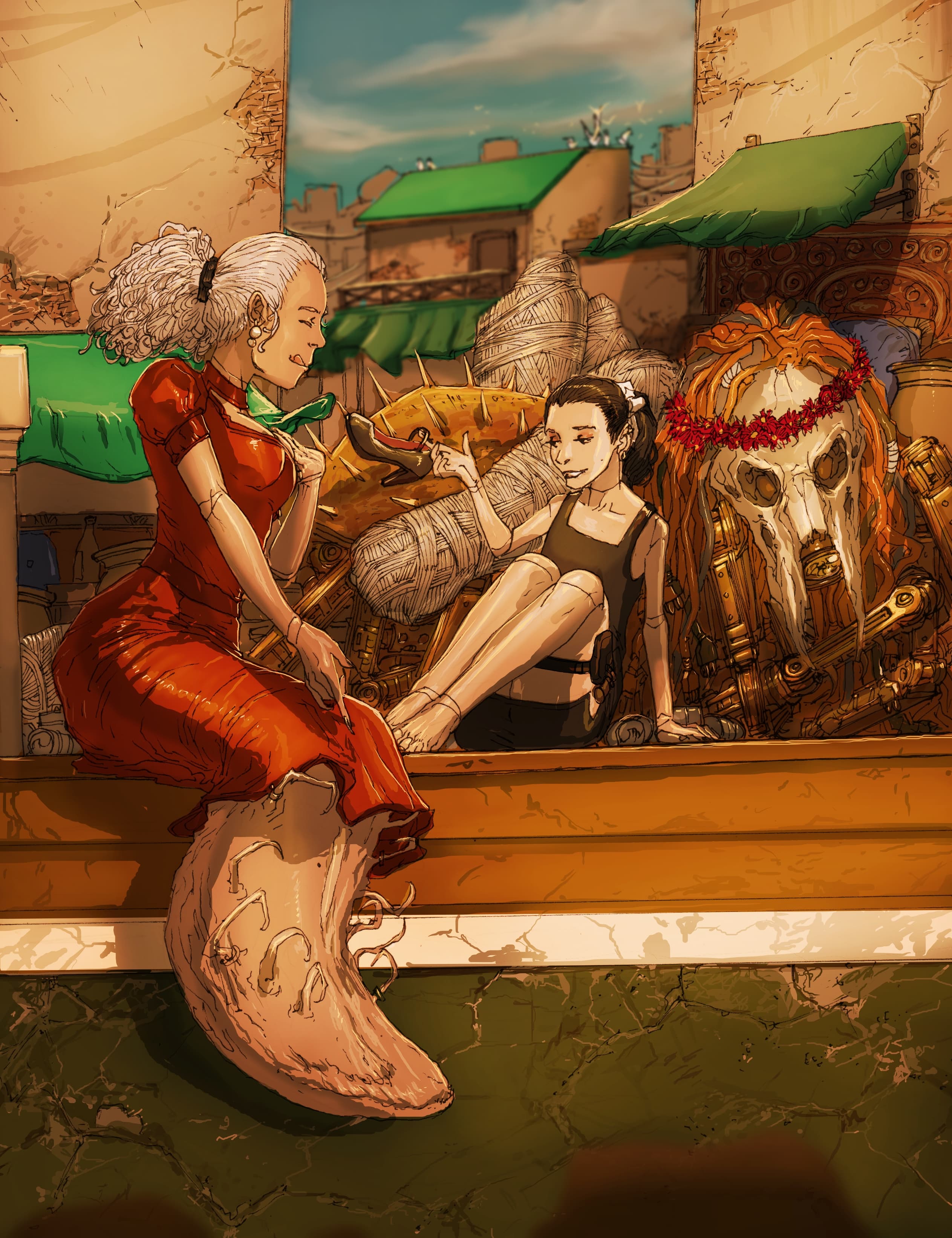
I need a piece between Teenage Morta and Decima, who are picking out witnesses for Decima’s wedding. Yes, another wedding. The frequency of her ceremonies is getting on Morta’s nerves.
The two women are perched on the rooftops of a desert bazaar, and Decima has her serpentine calves swung over the roof like Rupunzle's hair. Mortals below go about their daily lives trading meats, textiles, and eggs, completely oblivious to the duchesses. They cannot be seen save for those with close ties to the astral romances.
Decima licks her lips, picking out her witnesses like lobsters from an open tank, and Morta and Igor fetch them for her.
Morta and Igor: Teenage Morta is Decima’s chaperone and maid of honor, and she wears a black gown with a slit skirt, her hair done up in a white bow to complement her natural black. Though she’s dressed for a wedding, she has a Colt strapped to her thigh, and she slips out of her heels, twirling one of them by its straps on her finger as she leans against Igor.
In a sense, Morta is her sister’s opposite. Decima represents commitment and lasting attraction, while she represents hookups, one-night stands, and momentary pleasures. Death lives in the moment, for she never knows the time or the hour. Put simply, she isn’t cut out for a sweetheart romance, but puts up with the lipstick, nail polish, and garters because she loves her sister.
Though Morta is only a teenager, Igor is fully grown in this scene, and Decima has strung flowers in his mane and tied a string of empty tin cans to his saddle, which rattle across the ground as he trots, a wedding tradition from a more modern era. On the back of Igor’s saddle, we can see human-shaped cocoons bound tightly in steel wool. They’ve already selected a few witness, and Igor, like a spider, has wrapped them up snugly for the trip home. They struggle, unable to scream, squirming like bank robbery victims moments before being laid out on the tracks.
Decima: Teenage Decima believes it’s bad luck for the witnesses and the groom to see the bride in her gown before the wedding, so she dresses in her normal attire. However, her hair is already done up with a black ribbon like before, and she excitedly picks out witnesses among the oblivious crowds, waiting for Morta to do the heavy lifting. She licks her lips, the fingers along her calves twitching in expectation as her legs thump against the side of the building. Decima’s uncontrollable hunger peeks out from a pampered shell. After all, even Nona only gets one baby shower a year; three weddings at once is more than a little gluttonous.
Background: The duchesses have traveled to a human peninsula from a dated era. This place is a desert Bazaar, not too much unlike the one the Gnatu oversee, just without the sunken ships. Think colorful tarps, numerous tents, clay huts, and dome rooftops. The people wear simple attire and light robes to deal with the sun’s heat. With that said, you don’t have to be too detailed here, as, once again, the focus should be on Igor, the sisters, and their strange collection of steel wool wrapped victims.
If you’ve made it to the end and found your way here, you’re probably curious about what you just read. I’m glad you are. Let me walk you through these pieces in the author’s notes below which includes some of my original concept artwork:
This chapter contains a small easter egg that longtime readers may appreciate.
Near the end of the chapter, Morta and Decima are, in essence, shopping for witnesses when they notice a young girl surrounded by Gnatu. Morta is immediately struck by how much the child resembles Nona. More curious still is the behavior of the Gnatu themselves. They gather around the girl with an unusual familiarity, responding to her almost as though she were one of the Sisterhood.
By now, we should have a fairly good understanding of how the Gnatu behave around the daughters of the Immaculate Machine. So why would they respond this way to an ordinary mortal? The answer lies in something we discussed much earlier: the Barimorian women. To understand Leah, we must first understand them.
Barimorian women are exceedingly rare. They are known as the chosen of Nona, Duchess of Fertility. Through a strange accident during the weaving of fate, they become something that exists somewhere between mortal and divine. A kind of demigoddess.
Their creation is never intentional.
From time to time, while weaving a mortal woman's tapestry, Nona pricks her own finger. A single drop of divine blood falls into the weave, binding itself not to the woman's veins, but to her fate itself.
The most recognizable sign of a Barimorian woman is her crimson hair, said to reflect not the color of blood, but the color of Nona's own tapestry.
With that in mind, it becomes increasingly likely that Leah is one of them. "But she has brown hair," you might object. She does. At least, that is what we are told.
Remember, however, that Barimorian women are highly sought after and frequently sold to the highest bidder. Many spend their lives disguising their appearance to avoid attracting attention. Dyed hair is a small price to pay for anonymity. Leah herself is destined to become a central figure in another, as yet unfinished, novel alongside Caladrius, so I won't venture too far beyond that point.
There is, however, another reason she stands apart. Leah was not touched by one deity. She was touched by two. In addition to Nona's blessing, she also bears the mark of the Basilisk.
Leah is one of the Children of Ice.
Although they often occupy a similar niche within folklore, the Children of Ice are not vampires in the traditional sense. They do not hunger for blood but warmth. When they feed, they draw heat from the living until nothing remains but frozen husks. Their curse is not thirst, but cold. Yet when Leah lays a hand upon Morta, something remarkable happens.
She finds an endless fire.
The daughters of the Oxidized Garden were born beneath the relentless heat of the Immaculate Sun. The flames burning within them cannot simply be exhausted, no matter how desperately Leah draws upon them. Despite this, her own gift is equally extraordinary.
Leah reverses one of the most fundamental laws of nature.
Ordinarily, heat flows from regions of high temperature to low. In Leah's presence, the opposite occurs. Wherever she places her hands, warmth flows from the colder object into the hotter one, violating the very principles of thermodynamics. Such a contradiction immediately betrays the origin of her power. It is eldritch.
The elder gods, after all, are not bound by the laws they created.
We already know that the Great Devourer embodies entropy itself. Her twin, the Basilisk, governs another of the universe's great constants: the direction in which heat flows. What mortals understand as the Second Law of Thermodynamics is, in this world, simply an extension of the Basilisk's authority. Those touched by its blood occasionally inherit the ability to bend that law. Leah is one such child.
There is one final detail worth mentioning.
The Children of Ice are often regarded as second-class citizens within the Realm of Glass. Those who sit upon the Court of Nine Lives wield a far more refined mastery over their element. They do not freeze matter but transform it into true glass, borosilicate and otherwise. Their abilities arise from an altogether different source: a strange infection carried by creatures known only as the Whistlers.
But that is a story for another time. For now, know that Leah has a greater role to play in the Novels to come. Her story has only just begun.
