Gooday everyone,
Welcome to the Deacon Corner. If you’re new here, this space dives into the inspirations behind the images you’ll find throughout the books on these pages. What began as a place to share commission breakdowns has grown into something more. In addition to detailing how each piece came to life, you’ll now find expanded chapter notes, lore entries, and my own black-and-white concept illustrations which are raw glimpses into the ideas that shaped this world before they fully took form.
Before we begin, it’s important to say that none of the beautiful stylized images found in the hard and soft copies of these books would exist without the incredible talent of Sickjoe who is quite literally the heart and soul of this visual world. If you appreciate his work as much as I do, I highly encourage you to visit his gallery and explore more of his creations.
Now, without further ado, let’s take a look at the featured image and learn a bit more about the lore hidden in this chapter.
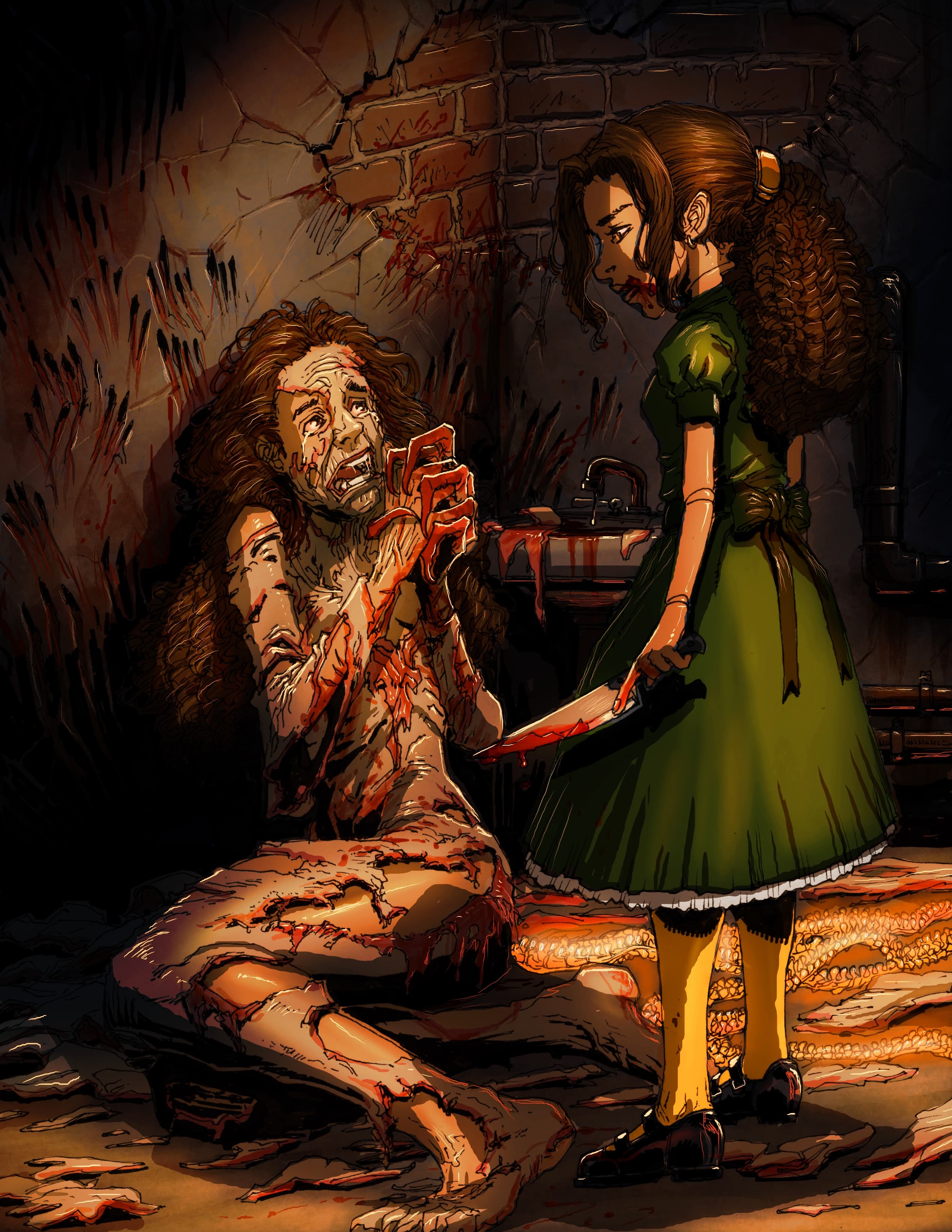
In this piece, I need something detailing the odd relationship between Nona and her mother.
Nona has been secretly caring for the woman for thousands of years and has stolen her fate from the isomerase so her sister Morta can’t kill her. Nona’s mother exemplifies what happens when a human lives far beyond her years.
Nona’s mother: She’s lying against a basement wall, twisting in agony, beads of sweat staining her gown as she pleads with her daughter to let her go. Her wrinkles and any signs of old age are peeling off of her like a serpent shedding her skin. As a result of her constant molting, she’s youthful for a woman who’s thousands of years old and Nona bears a striking resemblance to her. They are related after all. However, there are signs outside of her molting that hint at something wrong. Her fingers curl into claws and she is bleeding profusely from open wounds along her wrists, many scars covering her arms. She has tried to kill herself many times, but Nona is always there to stop her. She’s living a true nightmare and there is no escape.
Nona: We’re going to be working with teenage Nona here. She’s just forced a kitchen knife from her mother’s hand, her dress, her hands, and her lips stained with blood. She’s ignorant of her mother’s plight and refuses to let her die.
The main theme here is that Nona is oblivious to how serious her mother’s condition is. The woman is no longer herself begging her daughter to let her die, but Nona refuses, safeguarding her tapestry and allowing Madeline’s suffering to continue. It’s the first inkling we get that Nona may not actually be one of the good guys, her negligence and refusal to accept her elder sister’s role leading to untold suffering.
Background: We’re in a damp cellar with leaking pipes, loose concrete, and shoddy brickwork. An old sink drips in the back and tissue and skin hang from the lights, the walls, and the pipes. There’s evidence all over of a snake's shed skin. Furthermore, all around where Nona and her mother sit, an otherworldly tapestry lays (Like the ones hanging from the isomerase). Nona has stolen her mother’s fate from the garden and hides it here on a human peninsula.
If you’ve made it to the end and found your way here, you’re probably curious about what you just read. I’m glad you are. Let me walk you through these pieces in the author’s notes below:
On Kilns, Death, and the Gifts of the Sisters
Last time, we discussed the peculiar burdens carried by the Sisters of Fate. This week, it seems fitting to explore some of the more unique abilities that accompany their stations.
In this chapter, we see one of Nona’s most unusual talents. She can read a woman's kiln.
As the Duchess of Fertility, Nona possesses an almost supernatural sensitivity to the presence of life. To her, every kiln carries a distinct signature, a pattern as recognizable as a voice. Through that signature, she can perceive the existence of unborn children long before anyone else.
Curiously, this ability extends beyond direct parentage.
A kiln bears traces not only of its own offspring but of those connected to neighboring kilns as well. Sisters, daughters, mothers, and even more distant familial bonds leave faint impressions. To Nona, these echoes are impossible to ignore. Every potential child carries a unique resonance, and she can hear them all.
Unfortunately, this gift has also fostered a rather unpleasant bias.
Nona heavily favors women capable of bearing children and often dismisses the concerns of those who cannot. Fertility, to her, is not merely a blessing but purpose. Those who lack it frequently find themselves overlooked by a duchess who struggles to understand lives that do not revolve around creation.
Which makes her relationship with Morta all the more interesting.
By every reasonable measure, Morta should be sterile. She is, after all, the first of the stillborn. Yet Nona refuses to accept this conclusion. She insists that even a stillborn will one day become a mother.
Though never stated outright within this novel, Nona's conviction stems from something she believes she hears within Morta's kiln, an echo of a life yet to come. To Nona, that faint resonance is proof enough. It convinces her that her sister's condition can be corrected and emboldens her to pursue a series of increasingly questionable experiments.
What those experiments entail is a story best saved for another time.
Nona is not the only sister blessed, or burdened, with unusual perception. Morta possesses a similar instinct for death. Where Nona hears the promise of life, Morta senses its end.
From the moment she meets someone, she can vaguely sense how they will die. Sometimes it arrives through touch. Sometimes through a passing glance. The details are rarely precise, but the certainty remains.
She has always considered this ability frustratingly useless.
Morta cannot prevent a death. She can only alter the road leading toward it. As a child, she became obsessed with testing this limitation.
One of her earliest experiments involved a sailor whose fate she sensed immediately. She felt too much water in the wrong place and concluded he was destined to drown. Determined to prove herself wrong, she imprisoned him aboard her battleship, isolating him from every ocean and river she could find.
The sailor died anyway, his lungs slowly filled with fluid from pulmonary edema caused by congenital heart failure.
The sea had never been the threat.
It was a lesson Morta never forgot.
Death, it seems, is far more stubborn than circumstance.
Then there is Decima. Her gifts are perhaps the hardest to define. Where Nona embodies fertility and Morta death, Decima's authority manifests through passion, longing, and hunger. Much of this appears connected to the lingering effects of the Mangle still trapped within her body, confined below the ankle where the Sea of Storms failed to reach.
She is drawn to affection in all its forms.
Love fascinates her.
Given the opportunity, Decima will weave traces of it into nearly every mortal tapestry she touches. Some seams receive only the faintest thread of companionship. Others are saturated with romance, devotion, or heartbreak.
Whether a mortal ultimately chooses those seams is beyond her control. That decision belongs to them. Still, she continues to weave them. Because unlike Morta, who knows how every story ends, and unlike Nona, who listens for lives yet to begin, Decima remains captivated by possibility.
And perhaps that is how her power is best described. Decima is the lifeblood of possibility.
