Gooday everyone,
Welcome to the Deacon Corner. If you’re new here, this space dives into the inspirations behind the images you’ll find throughout the books on these pages. What began as a place to share commission breakdowns has grown into something more. In addition to detailing how each piece came to life, you’ll now find expanded chapter notes, lore entries, and my own black-and-white concept illustrations which are raw glimpses into the ideas that shaped this world before they fully took form.
Before we begin, it’s important to say that none of the beautiful stylized images found in the hard and soft copies of these books would exist without the incredible talent of Sickjoe who is quite literally the heart and soul of this visual world. If you appreciate his work as much as I do, I highly encourage you to visit his gallery and explore more of his creations.
Now, without further ado, let’s take a look at the featured image and learn a bit more about the lore hidden in this chapter.
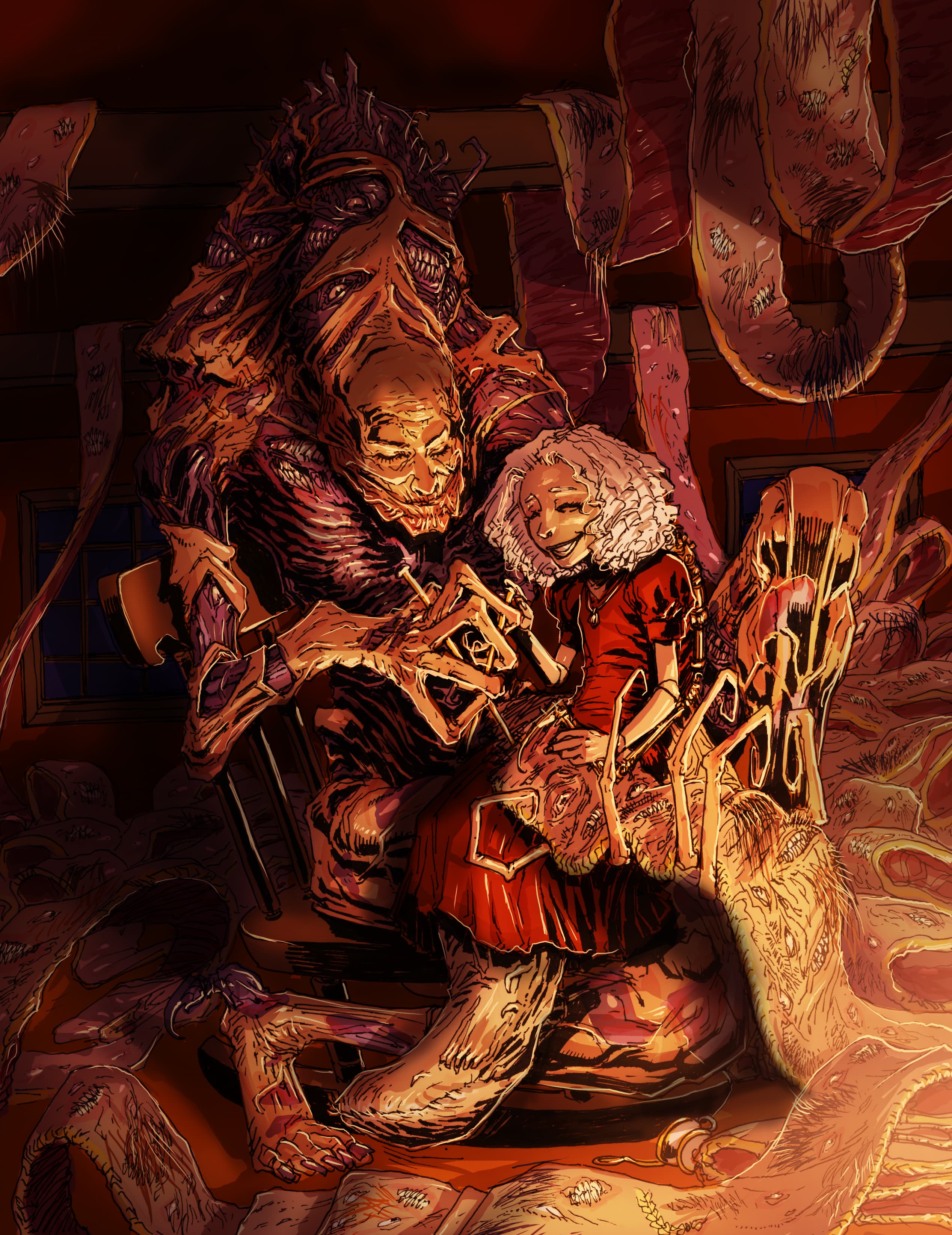
Lachesis: So, if Atropos is the young woman and Clotho is the child, then Lachesis is the crone. Decima envisions her as a decrepit old woman, graying wisps of hair, and fingers, long and boney, like the extended appendages of a daddy long legs spider.
Lachesis weaves an endless tapestry sitting on an old rocking chair like the kind used in creepy horror shots, cobwebs and dust, illuminated by a sliver of light. There is something undeniably dangerous about her, the precision of her needle and the steadiness of her hand, a strength no woman of such advanced years should possess. She is a crone, her frailty, a façade. Beyond the wrinkles of her face, is thick skin, callous, and bone.
As a more visual reference, I always imagined her looking something like the crone Gamall from the obscure thief franchise. I liked how they portrayed such a creature, wearing the face of an old woman but having the body of something else entirely, bone, skin, finger, and claw.
Decima: She’s a tyke here and is sitting in Lachesis’s lap, her legs draped over the older woman’s knees and thumping against the floor like a dog’s wagging tail. Decima stares intently at the woman’s needlework, an attentive student, desperate to prove herself, to take the needle, and try for herself. Decima sees Lachesis as her grandmother and the manipulative crone often takes advantage of that. Once again, despite how horrifying Lachesis is, Decima isn't afraid which is a common theme with the sisters. Their world is so vastly different from the mortal peninsula's, that these strange, corrupt, and often deadly beings don't frighten them.
Background: Decima dreams of a lonely cabin in the woods. No one to disturb her and her mother as they work tirelessly on an endless tapestry. A manifestation of her desire for family warmth. The tapestry itself has grown so long that it hangs from the rafters, travels up the stone chimney, beneath the dusty floorboards, across the tables, under the chairs and beneath the windowsill. In fact, the strange quilt covers just about everything, knocking over the silverware, tipping the pitchers, little room in the log hut for aught else but the girl, her mother, and the old rocking chair. Furthermore, we notice something strange about the tapestry. Hidden in the weave, we see eyes, teeth, and hair. A rather sinister quilt made from unorthodox materials. What exactly is Lachesis teaching her grandchild to do?
In many ways their relationship represents Decima’s naïve innocence and Lachesis’s sinister tutelage. After all, Decima is blissfully unaware of what Lachesis does when she sleeps so soundly at night. A secret Morta, who is complicit in feeding Lachesis’s perverse appetite for human flesh, promises to take to the grave.
A true crone through and through.
If you’ve made it to the end and found your way here, you’re probably curious about what you just read. I’m glad you are. Let me walk you through these pieces in the author’s notes below which includes some of my original concept artwork:
On the Sickness in the Weave:
For this week, let’s turn our attention to the weave itself and to Morta’s perceived role as a duchess of death.
By now, we should be familiar with the appearance of mortal fate and the tapestries woven by the Sisters. Each tapestry contains the potential pathways of a single life, divided into twelve seams. As we have discussed before, a mortal ultimately commits to only one of these paths, sealing away all the joys, tragedies, and possibilities hidden within the others.
Despite the illusion of countless futures, every tapestry ends in much the same way: with a slow accumulation of sediment gathering at the far end of the weave where the thread ceases.
This is the place where all lives end. But what exactly is this sediment?
To answer that, we must briefly revisit Adelaide’s bargain.
Long ago, Adelaide sought a kiln of her own so that life might be conceived through passion rather than violence. In exchange, she accepted a gift from the lineage of the Great Devourer, a bargain that carried a hidden cost. Her descendants inherited not only the capacity for love and creation, but also a terrible curse.
The Mangle.
Every mortal born from Adelaide’s lineage carries some dormant fragment of that corruption.
The sediment gathering within their fate is the physical manifestation of this sickness. It accumulates slowly across a lifetime, marking the inevitable return to something older and more primal. In a sense, every mortal is being pulled backward toward Daedalus’s original vision of perfection. Not the softness of Adelaide, but fang, claw, and conflict.
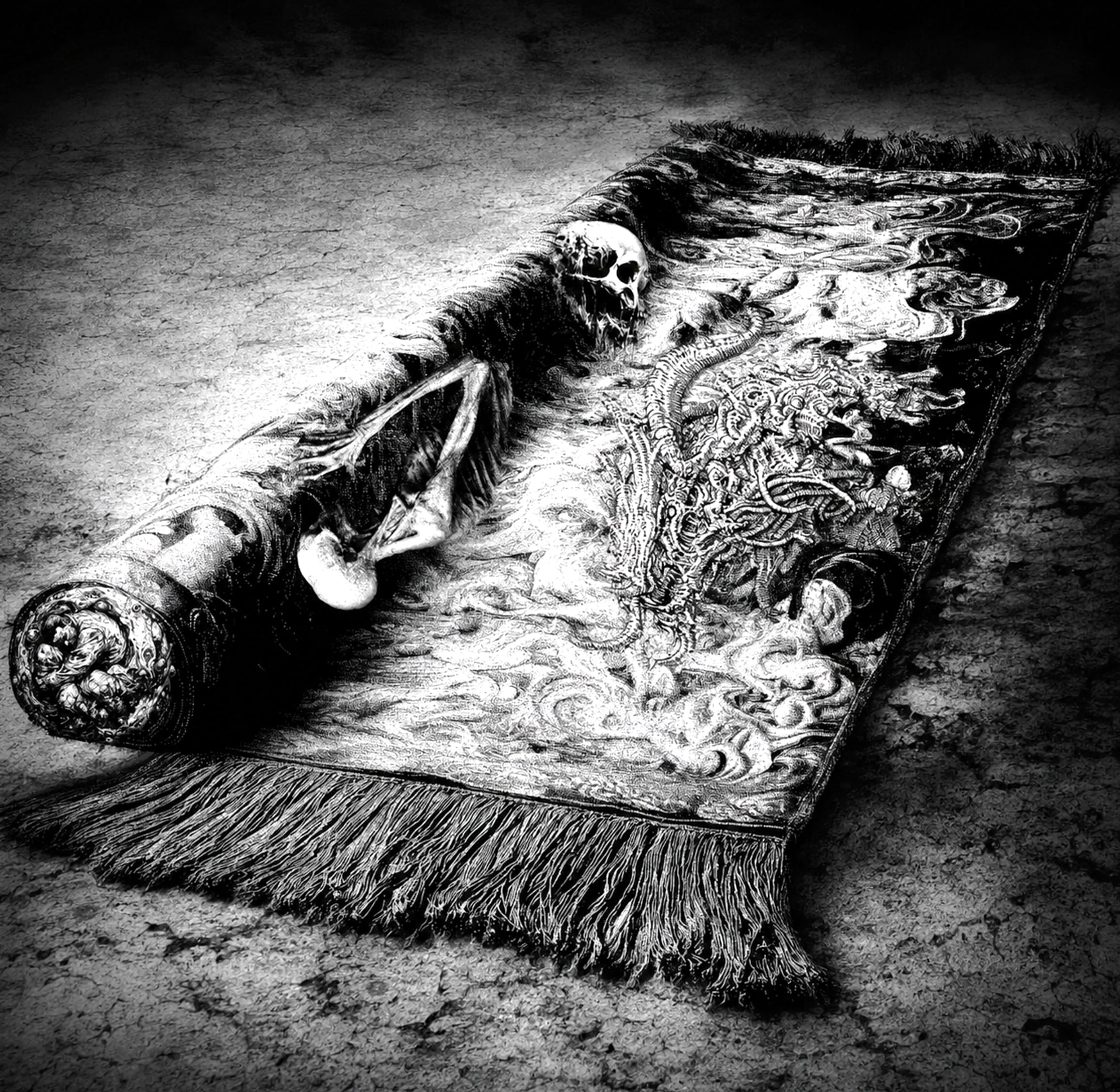
This is why no one, not even the Sisters themselves, can read fate beyond that final accumulation. The tapestry simply ends.
For all their authority over mortal destiny, there comes a point where the Sisters can no longer follow the thread. The hand guiding fate changes. The weave passes beyond their dominion into something stranger.
The fate of beasts does not belong to the Sisters, and another force governs what comes after.
We do not yet know whose hands hold those threads, only that they are translucent, hidden, and old enough to inspire fear in Iapyx himself.
This reframes Morta’s role entirely.
She is often mistaken for a goddess of death, as though her duty is to end lives, but death is not what Morta governs. Her true responsibility is mercy. Because beyond the sediment, beyond the place where mortal fate can no longer be read, lies something unknown. Something ancient.
And whatever waits there…
Even the father of fate wanted no part in it.