Gooday everyone,
Welcome to the Deacon Corner. If you’re new here, this space dives into the inspirations behind the images you’ll find throughout the books on these pages. What began as a place to share commission breakdowns has grown into something more. In addition to detailing how each piece came to life, you’ll now find expanded chapter notes, lore entries, and my own black-and-white concept illustrations which are raw glimpses into the ideas that shaped this world before they fully took form.
Before we begin, it’s important to say that none of the beautiful stylized images found in the hard and soft copies of these books would exist without the incredible talent of Sickjoe who is quite literally the heart and soul of this visual world. If you appreciate his work as much as I do, I highly encourage you to visit his gallery and explore more of his creations.
Now, without further ado, let’s take a look at the featured image and learn a bit more about the lore hidden in this chapter.
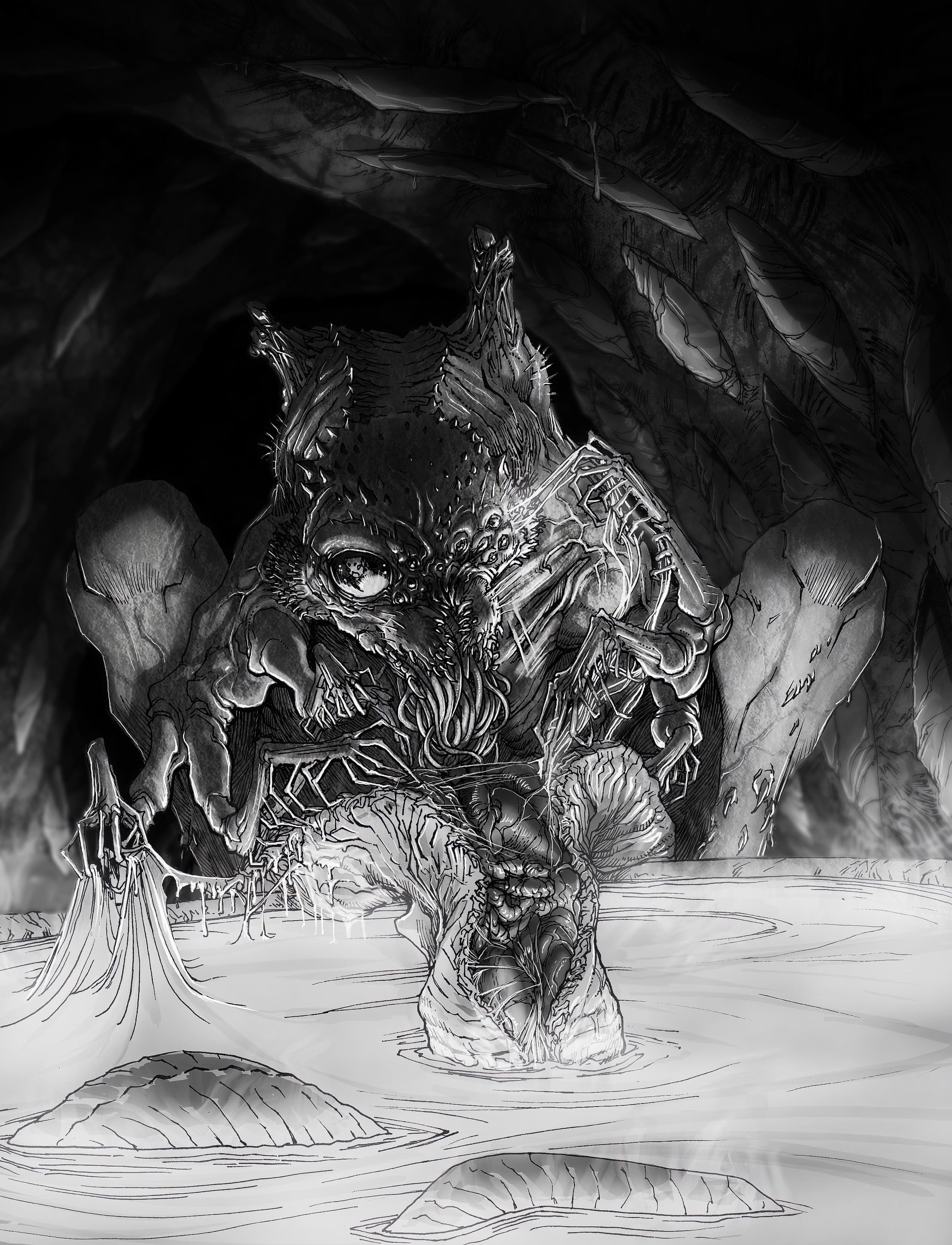
Icarus was once a crusader; a glory-hungry warrior from beyond the stars and the only engineer ever allowed to enter Kath’le Kal, the sacred realm of the Devourer. Unlike the other engineers who were shaped within her fold, Icarus came from the outside, forged in a crucible of blood-soaked worlds that orbit too close to the great Leviathans. There, the laws of reality twist and blood rains from clear skies where war is constant. It is from this cursed crucible that the Crusaders hail, seeking glory in endless battle against the mortal races.
Kath’le Kal, the inner sanctum of the Devourer, was long forbidden to these outsiders. Yet Icarus achieved so much on the battlefield that the Devourer granted him passage, welcoming her prodigal son into the realm every Crusader longed to reach.
But it was a lie.
Kath’le Kal is no paradise. It is a prison. A vast, empty desert ruled by silence and sand, where mindless larvae worship an empty throne. Glory is absent. Purpose is hollow. And Icarus, who once soared on wings of conquest, found only torment.
In his boredom and bitterness, he sparked the Pallid Wars. Wars meant to shake the desert from its slumber. Wars that became so great he was eventually defeated by his steward Xerxes, who ripped the wings from Icarus’s back. From that day on, Icarus was mocked as The Rat King, for what else could a wingless tyrant rule but vermin?
Even now, when he takes new vessels, the bloody stumps of his severed wings always return, a cursed reminder of what he once was.
Yet Icarus endures. In secret, he has become the Shaper of Shapers; a hidden hand guiding the evolution of his fellow engineers. Over millennia, he tweaks, perfects, and refines them, not out of loyalty or duty, but in the desperate hope that one day, one of them will be worthy enough to kill him.
And still the question lingers: Was it a mistake for the Devourer to yield the throne to a crusader? Or was it her design all along?
Visually, Icarus is monstrous and regal, his body marked by centuries of transformation. He bears multiple eyes, though one of them is not his own. Within it, hidden deep, sleeps our little leech, Velbrava.