Gooday everyone,
Welcome to the Deacon Corner. If you’re new here, this space dives into the inspirations behind the images you’ll find throughout the books on these pages. What began as a place to share commission breakdowns has grown into something more. In addition to detailing how each piece came to life, you’ll now find expanded chapter notes, lore entries, and my own black-and-white concept illustrations which are raw glimpses into the ideas that shaped this world before they fully took form.
Before we begin, it’s important to say that none of the beautiful stylized images found in the hard and soft copies of these books would exist without the incredible talent of Sickjoe who is quite literally the heart and soul of this visual world. If you appreciate his work as much as I do, I highly encourage you to visit his gallery and explore more of his creations.
Now, without further ado, let’s take a look at the featured image and learn a bit more about the lore hidden in this chapter.
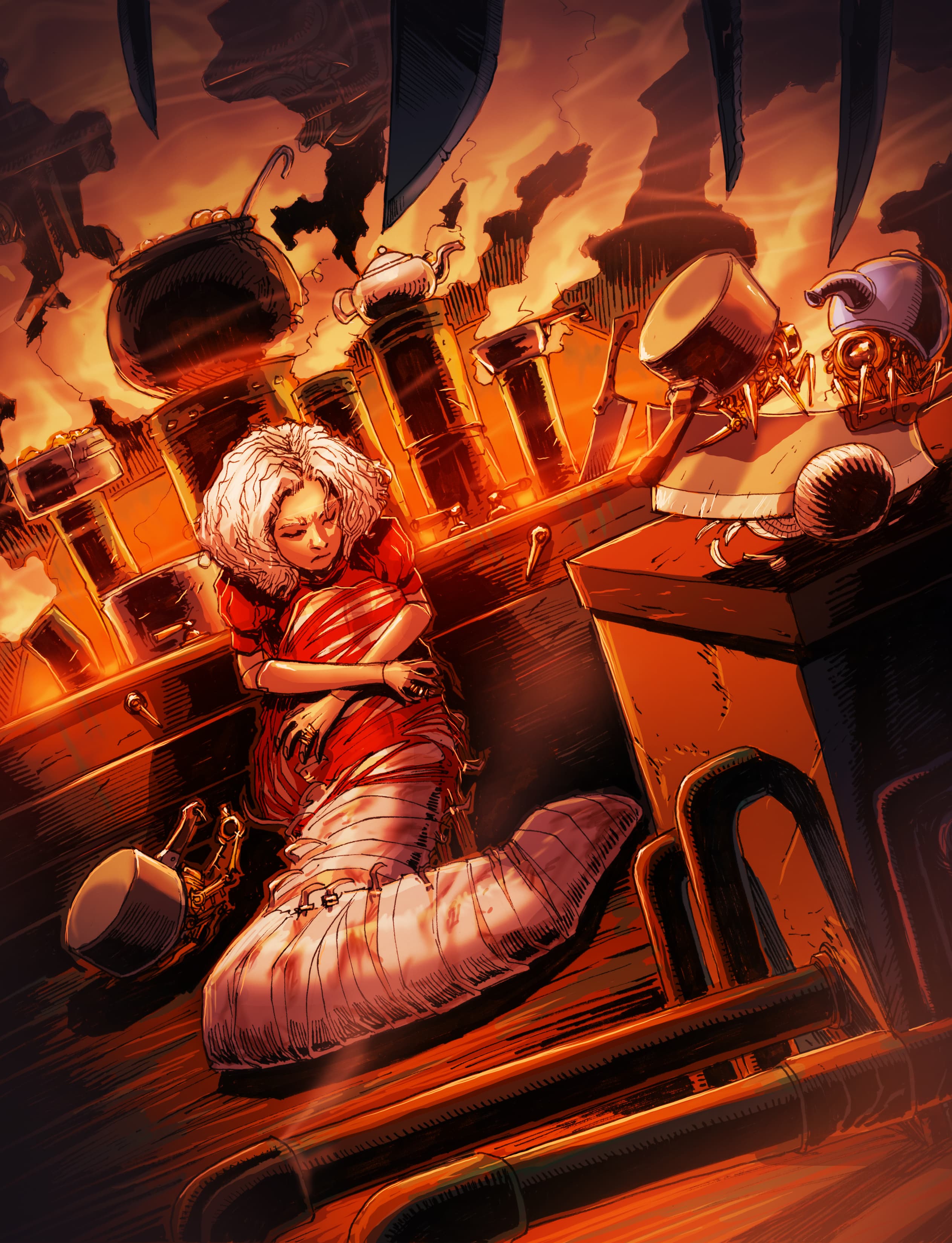
Continuing with the Tyke theme, I'd like a piece with Decima this time. Even as a child, Decima was obsessed with the concept of love but was deeply depressed because of her inhuman half. Out of desperation, she attempts to cut off her legs using a kitchen knife but fails miserably when the Gnatu find her and force her to stop.
Decima: Tyke Decima looks a bit more disheveled in this scene. Her dress is torn, her hair is messy, and her calves are bandaged up to the tip of her toes like mummifying a serpent. She bleeds through her dressings, the wound under her knees still fresh. The fingers along her legs slap at her hands, her calves bearing vestigial fangs and hissing at her. Decima’s other half doesn’t trust her anymore…
Gnatu: These guys are a little different from before. Instead of wearing toolboxes, outlets, and drill bits, the Gnatu in the kitchens hide under tea kettles, skillets, pots, pans, and cracked sugar jars. They cover the countertops and floors, gathering around Decima to protect her from herself. Much like Morta, Decima begins emitting a code of her own. Her desire to be loved manifests in the charges around her, and the Gnatu drop to their knees offering her colorful tungsten washers like wedding bands, red, blue, green, purple, and gold, perfectly sized to her fingers. Decima’s serpentine calves may be pissed, but she blushes fiercely, unable to bottle her emotions. She has such a naive concept of love that she agrees to marry any who asks her, and thus begins her nervous tick of collecting wedding bands. Fact or fiction, Decima loses all desire to harm herself as the Gnatu have convinced her that she is beautiful. In summary, think of it as a really screwed up beauty and beast scene, only the tea kettles, pots, forks, and spoons aren’t sentient, but the things living in them are.
Background: We’re in the cathedral kitchens here, which maintain much of the structure from the main hall, built with lead pipes and cast-off steel bits. A very steampunk version of a kitchen with stove tops bearing open-ended pipes emitting heated steam to boil pots. The Gnatu prepare food on the countertops, chopping meat and onions with oversized knives, having to ride the blades like a seesaw back and forth. Large butcher knives hang overhead, an ominous reminder as to why Decima came to this place. Since she’s a child here, I’d rather err on the side of caution and have the violence implied, droplets of blood seeping through her bandages, knives hanging overhead, etc.
If you’ve made it to the end and found your way here, you’re probably curious about what you just read. I’m glad you are. Let me walk you through these pieces in the author’s notes below which includes some of my original concept artwork:
On Decima, Necromancy, and Harmon Grieves:
In this chapter, we glimpse something uniquely unsettling about Decima’s abilities. She has learned to stimulate fragments of fate, tattered remnants trimmed from the greater tapestry, in order to draw out echoes of a life just before its end.
We already understand that Morta is the caretaker of death. She trims the tapestries, discarding what remains into the Origin Well. But Morta, in her own quiet way, is not without sentiment. On occasion, she keeps certain fragments hidden away… and offers them to her younger sister as gifts.
Decima takes these fragments and plucks at their threads. In doing so, she creates something that exists in a liminal state, neither fully alive nor entirely gone. These are echoes.
They manifest as ephemeral, semi-corporeal spirits that reenact the final moments of a life. Depending on the size of the fragment, this “life” may span a full day or only a few fleeting minutes. They are not conscious beings, not truly. They are recordings, loops of fate given just enough substance to interact with the world around them.
They can speak. They can move. They can even touch.
But they cannot deviate.
This is a lesson Decima learns the hard way. When she attempts to alter the course of an echo, stealing a kiss from a phantom whose final moments were shaped by fear, the illusion collapses. Morta explains it plainly: a frightened girl would never have done what Decima attempted. The deviation is too great.
And so, the spirit unravels.
These echoes are fragile things. Minor alterations, changes in scenery, slight differences in timing, can be tolerated. But meaningful divergence from their final script causes them to fall apart entirely.
What appears, at first, to be an innocent exploration of grief and curiosity is something far more insidious. This chapter marks the origin of one of the most disturbing magical practices across the peninsulas.
Decima is, in effect, the patron deity of necromancers.
But necromancy in this world does not concern itself with flesh. There are no shambling corpses, no animated skeletons. Instead, necromancers bind themselves to echoes, collections of fragmented lives, carefully curated and deployed. A necromancer’s strength is not measured by power, but by precision.
They must know their echoes intimately: who they were, how they died, what they were doing in their final moments. A soldier’s echo, for instance, is well-suited for violence. Throw it into the chaos of battle, and it will persist, its actions aligned with the conditions of its death. But an echo of a cobbler, felled quietly by a failing heart, will collapse almost immediately under similar strain.
To misuse an echo is to waste it, and to misunderstand it is to die.
This is the creed of all necromancers.
Thus, the most skilled practitioners are archivists of death, curators of circumstance. Their collections, often referred to as cupboards of spirits, are carefully assembled libraries of fate, each fragment chosen for a specific purpose.
But such collections require raw material. Necromancers must possess fragments of fate themselves stolen from the Oxidized Garden. These tattered pieces of tapestry are rare, dangerous to obtain, and deeply forbidden.
For most, there is an easier path. They seek out the Merchant of Death.
Harmon Grieves was the first to truly understand this art and the first to push it beyond all reason. Unlike others, he did not simply steal fragments from the Garden. He stole his own.
The stories say he died 137 times.
Each death was deliberate. Each was crafted. He would stage scenarios, shaping the moments leading to his end, only to be resuscitated shortly after. These repeated near-death experiences shattered his tapestry into numerous fragments each one containing an echo of a different possible end.
In his final act, he wove 136 of these fragments into a single construct: a grotesque, human-sized doll of cogs, pulleys, and stretched flesh, draped in the threads of his own fractured fate.
Then, satisfied, he hanged himself.
The 137th death was permanent, but, at the moment of his passing, the machine awakened. The fragments activated. The gears turned. The echoes aligned, and from that convergence, something new emerged.
Harmon Grieves was born again as an amalgamation of his own deaths. A being that no longer relied on a cupboard of spirits, but was one.
An abomination of layered fate, capable of enacting its will with a precision and resilience no necromancer has ever replicated. His secrets died with him, but his existence endures—an impossible standard, and a lingering terror.
Now, he wanders as the Merchant of Death.
Those who seek him may pray for an audience. If answered, he appears at sunset, offering fragments for trade. His price is always the same:
Blood.
Often, a necromancer’s first spirit is someone close to them. A lover. A sibling. A child. Such was the case for Diana Harmeet, whose first echoes were her own children.
For this reason, necromancers hide their craft. They live quietly, blending into ordinary life. Most people will never know they exist. But if one were to stumble upon a cupboard, filled with tattered, chimeric fragments that have long since lost the soft translucence of divinity, then their fate is already sealed.
They will not leave as they arrived.
In the end, all of this traces back to a single, fragile moment: A disfigured little girl, reaching for something she could not have. Decima did not set out to create necromancy. She only wanted a boy to kiss her.
And from that small, broken desire, one of the darkest arts in existence was born.
