Gooday everyone,
Welcome to the Deacon Corner. If you’re new here, this space dives into the inspirations behind the images you’ll find throughout the books on these pages. What began as a place to share commission breakdowns has grown into something more. In addition to detailing how each piece came to life, you’ll now find expanded chapter notes, lore entries, and my own black-and-white concept illustrations which are raw glimpses into the ideas that shaped this world before they fully took form.
Before we begin, it’s important to say that none of the beautiful stylized images found in the hard and soft copies of these books would exist without the incredible talent of Sickjoe who is quite literally the heart and soul of this visual world. If you appreciate his work as much as I do, I highly encourage you to visit his gallery and explore more of his creations.
Now, without further ado, let’s take a look at the featured image and learn a bit more about the lore hidden in this chapter.
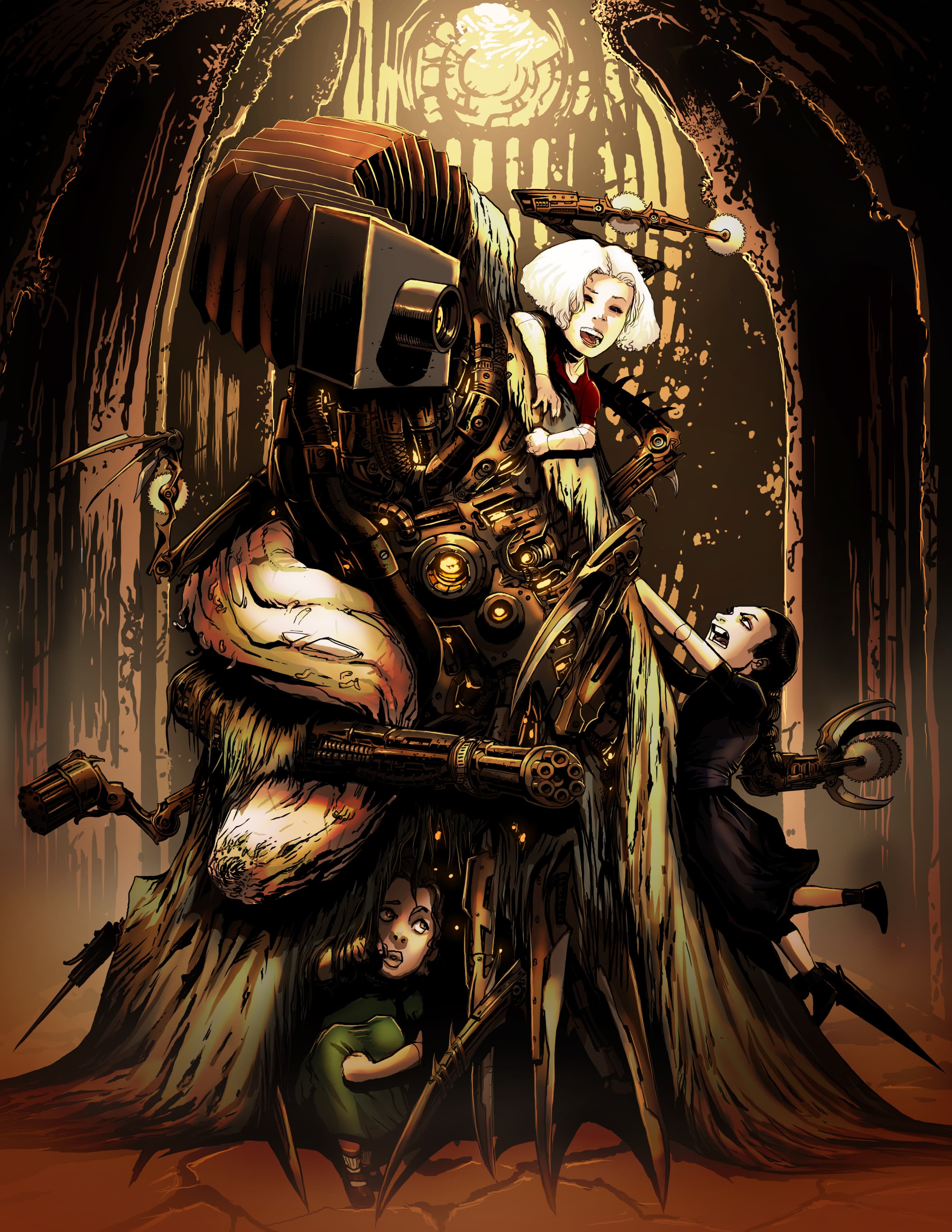
Bastion is an ancient war machine, repurposed as caretaker in the years following the Last Crusades. His primary role is to serve as an adoptive father to the Sisters of Fate.
Now, when I say machine, I don’t mean in the traditional sense. In this world, machines are the domain of Iapyx, an Outer God born of the Great Devourer, who forsook flesh to shape living metal. He is an engineer-deity, crafting his Eldriatus—living wasps made of iron, with copper tissues, magnesium pacemakers, and organs of smelted alloys.
Bastion is one of the first creations of this line, a Gnatu, known as a Conduit. These Conduits act as hiveminds for the lesser metal beings and were responsible for designing the original drone armies. Bastion himself is a towering construct of steel and burnished brass, with multiple arms built for both creation and destruction. His original, sacred duty was to safeguard Morta before her birth.
His frame is a patchwork of spinning blades, gun-barrel fingers, and powder-burned plating — a figurative and literal killing machine standing between any threat and the immaculate daughters of their Father.
For visual reference, Bastion possesses a single eye, resembling the lens of an old bellows-style vintage camera — think of something like the creature Obscura from The Evil Within franchise, though stripped of the ballerina affectation and made all the more terrifying for it.
Scene Concept:
In the moment I have in mind, the three sisters are climbing on and around him as though he were a playground jungle gym. A sight to make any sane adult shudder — children scrambling around spinning blades, gun-barrel fingers, and razor-sharp implements. But the sisters are unafraid. Bastion would never harm them, no matter how recklessly they dangle from his death-dealing limbs.
By law, by decree of their Father, he cannot harm them.
If you’ve made it to the end and found your way here, you’re probably curious about what you just read. I’m glad you are. Let me walk you through these pieces in the author’s notes below which includes some of my original concept artwork:
On Diodes
The first thing to note is that diodes are not meant for mortal anatomy. They can only be used by the Sisters of Fate and their kin, whose bodies are not bound by the same biological limitations as humans. They trade parts as easily as machines, though with far more elegant craftsmanship. In this chapter, the sisters surrender one of their eyes and seat a diode in its place. It slides into the socket as naturally as living tissue.
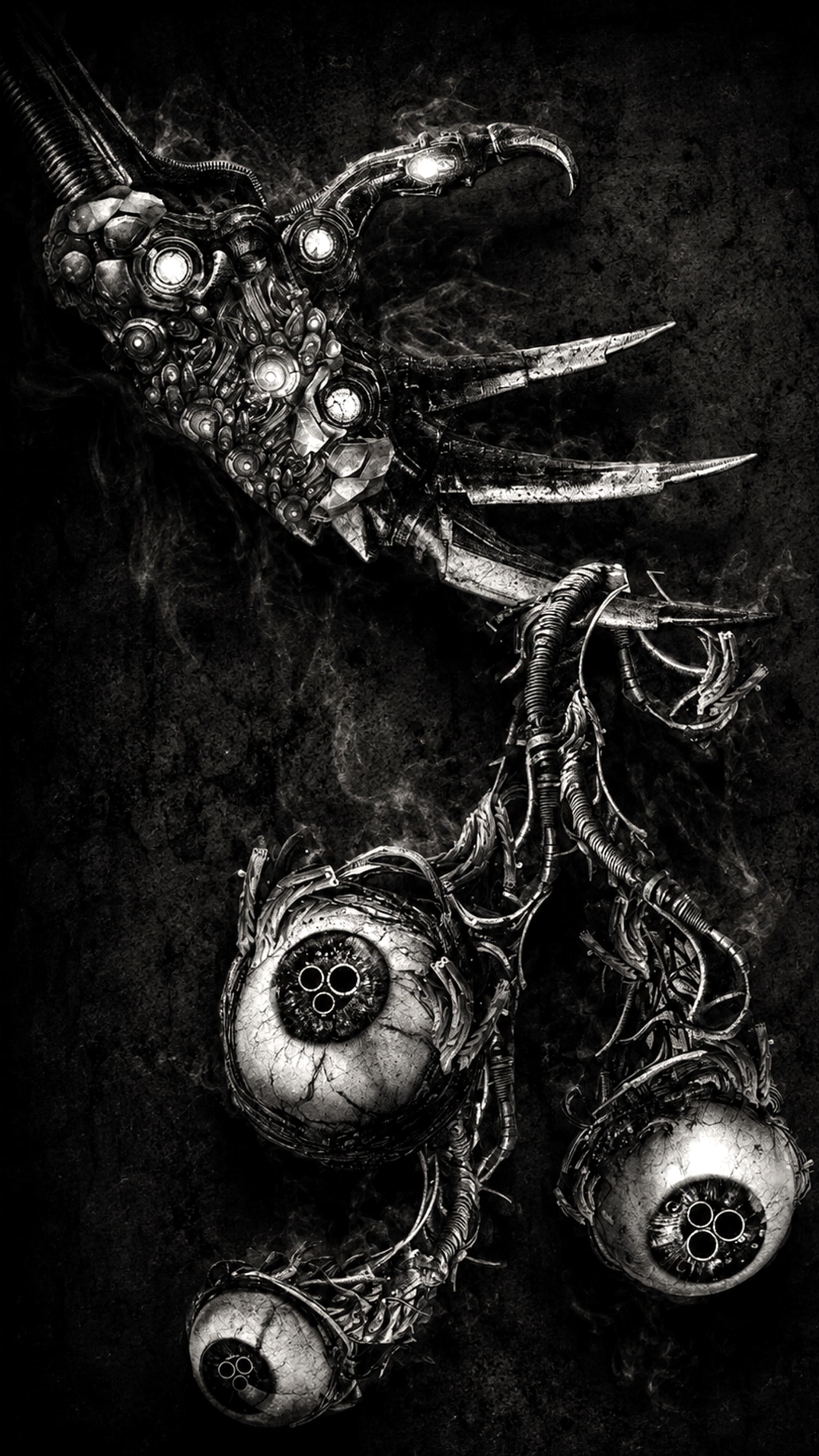
Diodes are what allow the sisters to see the weave of mortal fate and read it. Given their role in shaping destiny, it was perhaps inevitable that they would one day require the proper instrument.
That instrument is built from genesis pearls.
In an earlier draft of the novel, now removed, genesis pearls were mined directly from the corpse of Iapyx, the father of fate. His core condenses into dense, nearly indestructible gems. Nona once remarked that moons could be balanced atop them as easily as a cup of water on a cube of salt. Mining a single pearl takes centuries, sometimes millennia. The newest generation of Gnatu specialize in this labor, burrowing through their creator’s corpse, harvesting what forms only after generations of pressure and time.
Pearls, in nature, are born from an immune response, an irritation encased and calcified. If genesis pearls follow the same principle, then some part of Iapyx’s body still lives.
A true genesis pearl houses three circular disks embedded in its corneal surface, accretion disks. The same term used to describe the superheated matter spiraling around an active black hole.
Because that is precisely what dwells within a diode.
Three immutable black holes.
Consider, for a moment, the radiation such objects would produce. This is why only the Sisters can wield them. A mortal body would not survive long enough to read its own fate. In fact, prolonged proximity to the Fates themselves is dangerous. The immense gravitational forces are contained within the pearl, but the radiation is not.
This brings us to Decima.
She alone did not inherit a diode. Ironically, this makes her the safest sister for mortals to approach—despite her particular appetites. Without a diode, she cannot see the weave in the same way Morta and Nona can. Yet she feels it. In her mind’s eye, she perceives the tapestry in a more metaphorical sense.
Why was she denied one?
We know from Bastion that Decima’s body differs from her sisters’. Is she vulnerable to radiation? Unlikely, given her closeness to them.
The answer lies deeper.
Black holes are intimately tied to the Great Devourer and her pruned kin, the Leviathans. At the heart of every Leviathan lies a singularity. When the sisters inherit a diode, they are receiving a fragment of something akin to the Devourer herself.
They are, after all, related to her.
Iapyx, their father, was one of two brothers born of the union between the cosmic glutton and the cosmic steed. To implant an accretion disk within Decima, who is already so closely tied to her grandmother, would be to place her too deeply under the Devourer’s influence. Bastion could not risk it.
The accretion disks are different in color between the users, reflecting the wavelengths of the lives they lead. There are others who carry them, but their identities remain unrevealed. So, if you glimpse three luminous disks in a character’s eye, you now have a better understanding what you are seeing.
To piece it together:
Genesis pearls, each containing three black holes, are mined from the corpse of Iapyx, father of fate. Event horizons lie at the heart of every leviathan, so it can be inferred that Iapyx is being pruned by the Gnatu producing leviathans of his own which he embeds in his daughters eyes.
How’s that for a family inheritance?
On the Isomerase and the Central Dogma of Fate
If you have wandered the Oxidized Garden for any length of time, you are likely familiar with my interpretation of fate. Long before I knew the vocabulary, I envisioned human destiny as helical strands, tight superstructures bundled together in an impossibly small conformation.

Fortunately, such a structure already exists.
DNA and the Central Dogma provided the scaffolding for this entire metaphysical architecture.
In biology, the Central Dogma describes replication, transcription, and translation: the processes by which life produces protein. DNA must first be unwound before it can be read. It is packed so tightly around histones and coiled into such dense formations that, in its native state, it is almost inaccessible.
To put that into perspective, imagine this. Within a single human cell, so small it cannot be seen with the naked eye, there are roughly two meters of DNA folded into that microscopic nucleus.
Let that sink in for a moment, and get out your meter sticks.
One human cell has 2 meters of DNA if stretched out to its fullest. There are approximately 7-10 trillion cells in the human body. Multiply by 2 meters per cell, convert to miles, and you have one billion eight hundred ninety-three million nine hundred thirty-nine thousand three hundred ninety-three plus change miles.
Yes, if we were to link all of your DNA end to end, you’d be able to circle the solar system over ten times. I say this to impress upon you how amazing superstructures are capable of achieving a soft singularity within our own bodies.
In the Oxidized Garden, fate behaves the same way. Human lives exist first as unwritten helices, dense, coiled, and brimming with possibility. Financial triumph. Early tragedy. Medical anomaly. Love. Ruin. All of it exists in potential. The Sisters of Fate do not invent outcomes. There roll is to transcribe and translate, weaving unorganized possibility into functional tapestry.
But what of replication?
That is where the Isomerase enters.
Those of you who have wrestled with your MCAT review books will recognize the name. Topoisomerases are enzymes that unwind DNA, relieving tension so the code may be read. Without them, replication stalls. Transcription fails.
In the Garden, the Isomerase performs an analogous function. It manages the unwritten superstructure of fate itself. Above the Origin Well rests what I call the Central Dogma of Fate—a metaphysical engine that maintains, unwinds, and organizes mortal possibility.
Consider again the concept of singularity.
A black hole compresses the mass of stars into a point so dense that space and time decouple. Cause and effect become open borders without regulation.
As you move through the Oxidized Garden, you may notice that time behaves strangely. We leap centuries without warning. Nona hides her mother during an event reminiscent of the Salem witch trials, then later shelters her in a timeline more akin to our own. The Sisters weave a life from the twenty-first century while simultaneously knitting threads from the fifteenth.
They are never pressed for time because, in the Garden, time is not linear.
This suggests something profound: Iapyx achieved a singularity long ago.
But how did he achieve this?
Iapyx bundled the collective unwritten destinies of tens of millions of mortals across infinite peninsulas into a single core. Managed by the Isomerase, the Central Dogma of Fate produces a metaphysical gravitational field powerful enough to uncouple space from time within the Garden. The throne of Iapyx functions much like the core of a Leviathan.
This is why the Sisters may visit themselves across timelines. When Nona was a child, she often sought Morta as an adult. To Nona, her elder sister became something closer to a mother because, in many ways, she was. Time folds in dizzying patterns.
Now, where do the Sisters fit within this structure?
Nona and Decima are responsible for weaving unwritten fate into completed tapestries. We learn from Bastion that every tapestry must contain twelve seams.
A seam, in mundane terms, is where two pieces of fabric are joined. In the Garden, a seam represents a life path. Marriage. Career. Betrayal. Murder. Mercy. Once chosen, a seam cannot be undone. A mortal may believe they are free to reconsider, but each decision narrows possibility until only one path remains viable.
This was the bargain struck between Iapyx, Castor, and Pollux. Though the full weight of that agreement will be explored in a different novel.
Every human being possesses twelve seams. Within them lies the potential for happiness, but not the guarantee of it. Decima, despite her longing to gift every mortal an equal measure of joy, is bound by Garden Law. Balance must be preserved. When she was young, she attempted to craft a tapestry in which all twelve seams led to happiness.
For this, she was grounded for a thousand years.
Such symmetry would fracture the singularity. Too much light without shadow destabilizes the unwritten store of fate.
Iapyx is determined to maintain equilibrium.
And yet, singularities are not eternal.
Imagine, for a moment, that the Leviathans consume a mortal peninsula, Earth, for example. If mortal life ends, then unwritten fate becomes finite. The Central Dogma of Fate would slowly exhaust its stored potential. What happens when the Sisters deplete the unwritten superstructure?
The singularity collapses.
Space and time would merge once more. The Garden would lose its temporal elasticity. The Sisters would no longer be able to walk across time.
This collapse and merging of timelines and consequences is the beginning of what some might call Ragnarok.
Not merely the end of a world, but the end of unwritten possibility itself.