Gooday everyone,
Welcome to the Deacon Corner. If you’re new here, this space dives into the inspirations behind the images you’ll find throughout the books on these pages. What began as a place to share commission breakdowns has grown into something more. In addition to detailing how each piece came to life, you’ll now find expanded chapter notes, lore entries, and my own black-and-white concept illustrations which are raw glimpses into the ideas that shaped this world before they fully took form.
Before we begin, it’s important to say that none of the beautiful stylized images found in the hard and soft copies of these books would exist without the incredible talent of Sickjoe who is quite literally the heart and soul of this visual world. If you appreciate his work as much as I do, I highly encourage you to visit his gallery and explore more of his creations.
Now, without further ado, let’s take a look at the featured image and learn a bit more about the lore hidden in this chapter.
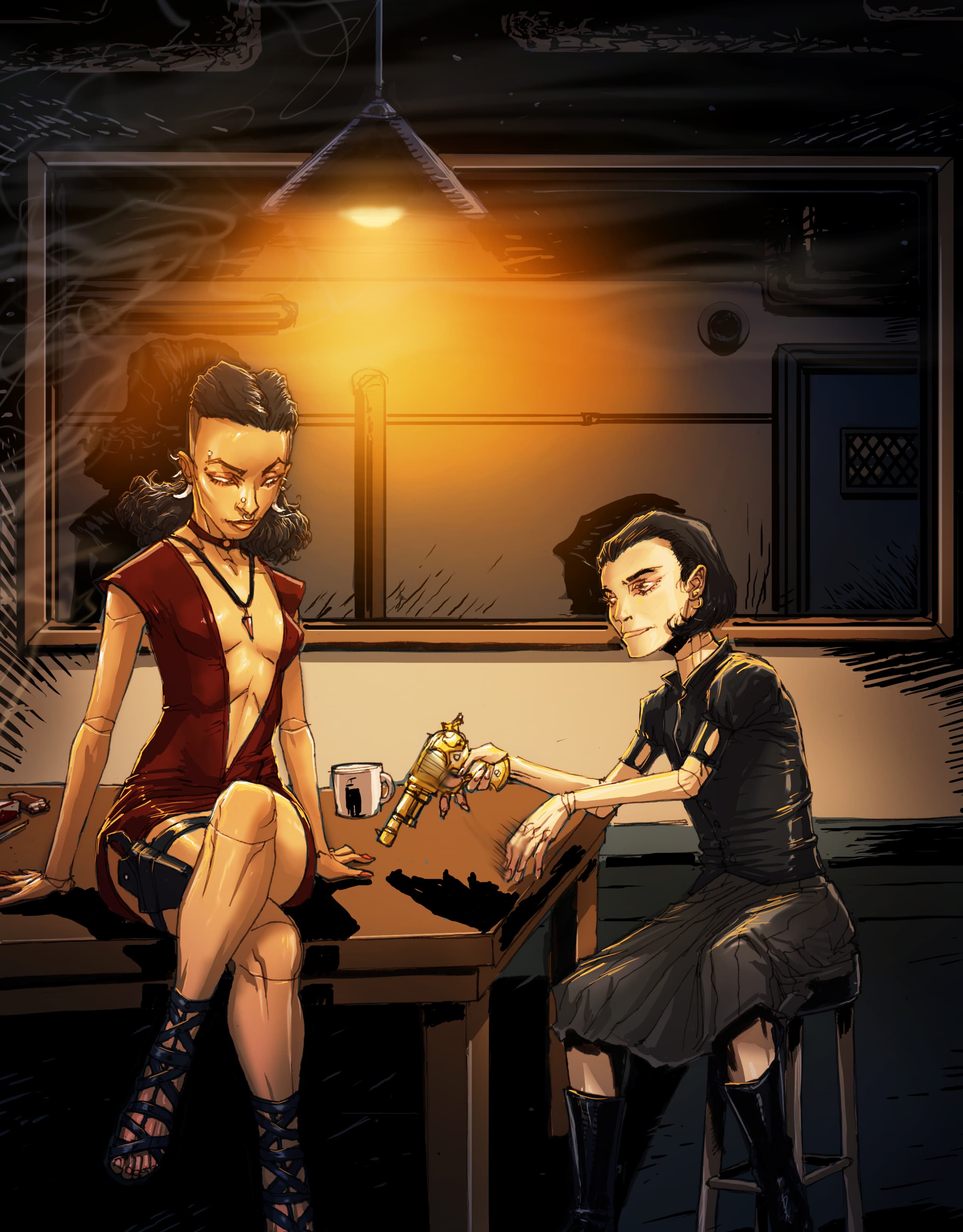
I’d like to have a few pieces on the constructs living in the heads of the sisters of fate. These beings are their other halves and help them weave fate by whispering in their ears. They meet only in dreams since the constructs aren’t physical beings, but, when summoned, they take the appearance of their host’s idealized version of themselves.
We’ll start with Atropos and Morta.
Background: This scene occurs in Morta’s head, a metaphysical dream space Atropos dwells in. The world is reminiscent of an interrogation room with a single hanging light, two stools, and an old wooden table. To quote Morta in this scene: Double-sided glass, stale coffee, a half-eaten doughnut, and an empty liquor bottle. This could only mean one thing. She wasn’t getting her phone call.
That Morta visualizes her dreamscape as an interrogation room is a reflection of her character. Unlike her sisters, Morta doesn’t feel free in her dreams but is imprisoned by them. She fears her idle thoughts and the devil that plays when she lets her mind wander.
Atropos: As mentioned, Atropos appears as Morta’s idealized version of herself, a mature woman. Morta longs for adulthood and Atropos reflects that appearing as Morta would fully grown. However, they aren’t exactly twins of different ages. Atropos shares Decima’s feminine qualities, wearing her hair down instead of in a braid, her skin a darker tanned color, a striking contrast to her sharp blue eyes. Atropos is aware of Morta’s insecurities and flaunts her beauty with short, revealing dresses, exposing a thigh holster for a short-range pistol as she sits seductively on the table.
Atropos is the reason Morta grows fond of such attire. You might say, she’s a terrible influence in addition to being batshit crazy.
Morta: In this sequence, Morta is now a teenager, and is thoroughly unamused by Atropos’s behavior. The two women are playing a game of Russian roulette, aggressively shoving a pistol back and forth between each other. What I mean to be most unsettling about this scene is that both appear completely unconcerned about a potential lead injection between the eyes. This game is as normal to them as tic tac toe. They are, after all, two halves of the same whole, and what exactly is normal in this strange world of theirs?
If you’ve made it to the end and found your way here, you’re probably curious about what you just read. I’m glad you are. Let me walk you through these pieces in the author’s notes below which includes some of my original concept artwork:
On What Lives in the Walls
This week’s notes will be a bit shorter than usual.
Unfortunately, this chapter brushes against several mysteries that venture well into spoiler territory, so there is only so much I can safely discuss without giving away things better discovered through the story itself.
In previous chapters, we witnessed a family being terrorized by something lurking within the walls and pipes of their home. At this point, all I can comfortably reveal is that a creature with a particular fondness for children dwells in that place, but its arrival wasn’t a coincidence.
The loss of a simple goldfish, an act of innocence, grief, and longing, drew the attention of something far older and far more dangerous than the family could understand. Once its gaze settles upon a household, it rarely leaves empty-handed.
The walls listen. The furnace speaks. And somewhere within those hollow spaces, a homunculus whispers the name of a mysterious deity:
Millia Gnu Aye.
Attentive readers may recognize that name from the short captions above each chapter, lurking at the edges of the narrative.
Unfortunately, this is not yet the right time to pull back the curtain. Some mysteries are best left undisturbed until the story is ready for them.
For now, it is enough to know that not everything lurking in the Garden wears a divine crown. Some horrors prefer narrower spaces: a crawlspace, a ventilation shaft, or the hollow cavity behind a bedroom wall.
So, if you find yourself bathing alone in an old house where the pipes groan, the floorboards creak, and the furnace seems just a little too eager to speak.
Be careful what you whisper.
You never know who might be listening.

On Steel, Mantles, and the Burdens They Carry
By this point in the story, we have begun to notice a peculiar pattern among the Sisters of Fate.
Morta, the first of the stillborn, physically manifests her station as the Duchess of Death through the blade embedded within her throat. We know from the prologue that Adelaide herself drove this strange steel into her daughter's neck. The act granted Morta a form of life and explains why she carries the weapon hidden within her nape.
Nona possesses a similar tool.
Though we know far less about how hers came to be, the similarities are difficult to ignore. For now, however, the more important question is not why they carry these tools, but where the steel originated.
The answer lies in Kath'le Kal.
Readers of The Pallid War may already recognize the significance of that name. Iapyx briefly reveals in the prologue that Morta's blade was forged from the steel of Kath'le Kal, a detail that quietly establishes a connection between the Sisters and the Engineers of the plains.
This chapter also reveals another unusual trait of Morta's.
She dies.
Not permanently, of course.
Her heart ceases. Her body flatlines. Yet her mind remains conscious through the intervention of Atropos, who promises to keep her lucid long enough to attend her sister's wedding. Death, for Morta, is not an ending but a recurring condition. A symptom of her mantle. We might call it pseudo-death.
In time, we learn that Nona suffers from a similar affliction tied to her own authority. As the Duchess of Fertility, she experiences pseudo-pregnancies. Though she never carries a child to term, she endures the full range of symptoms, morning sickness, mood swings, cramps, cravings, and all the physical burdens associated with motherhood. In a cruel twist, her body prepares endlessly for a child that never arrives.
Curiously, Decima experiences no such manifestation. She is also the only sister who lacks a tool embedded within her throat. Taken together, these observations suggest something important. The source of these afflictions may not be their mantles alone. Instead, the steel itself appears to play a role.
The blades of Kath'le Kal seem to evolve alongside their bearers, reshaped over time by duty, identity, and expectation. The responsibilities carried by the Sisters have, in a sense, reforged the metal into something new. What began as a tool has become a burden, an extension of the station each sister occupies. A cruel sort of symmetry. After all, home and comfort often shape us just as much as war and suffering.
If we turn briefly toward the lore of The Pallid War, we can see similar examples among the Engineers. There, we learn that Engineers possess a peculiar form of weather sense, allowing them to anticipate the coming of the Red Rain.
While never stated outright, this ability is likewise tied to the steel embedded within their bodies. Which raises an interesting question.
If the steel grants such gifts, why did Icarus never possess weather sense despite wielding a blade of his own?
It is because the steel was never truly his.
A blade may be carried, stolen, or borrowed, but that does not make it part of the bearer. The steel of Kath'le Kal forms a relationship with its owner, and only through that bond do its stranger qualities emerge.
Of course, to fully understand the nature of these blades, one must also understand kilns, engineers, war, and the ancient conflicts that shaped them.
But those are stories for another time.
