Gooday everyone,
Welcome to the Deacon Corner. If you’re new here, this space dives into the inspirations behind the images you’ll find throughout the books on these pages. What began as a place to share commission breakdowns has grown into something more. In addition to detailing how each piece came to life, you’ll now find expanded chapter notes, lore entries, and my own black-and-white concept illustrations which are raw glimpses into the ideas that shaped this world before they fully took form.
Before we begin, it’s important to say that none of the beautiful stylized images found in the hard and soft copies of these books would exist without the incredible talent of Sickjoe who is quite literally the heart and soul of this visual world. If you appreciate his work as much as I do, I highly encourage you to visit his gallery and explore more of his creations.
Now, without further ado, let’s take a look at the featured image and learn a bit more about the lore hidden in this chapter.
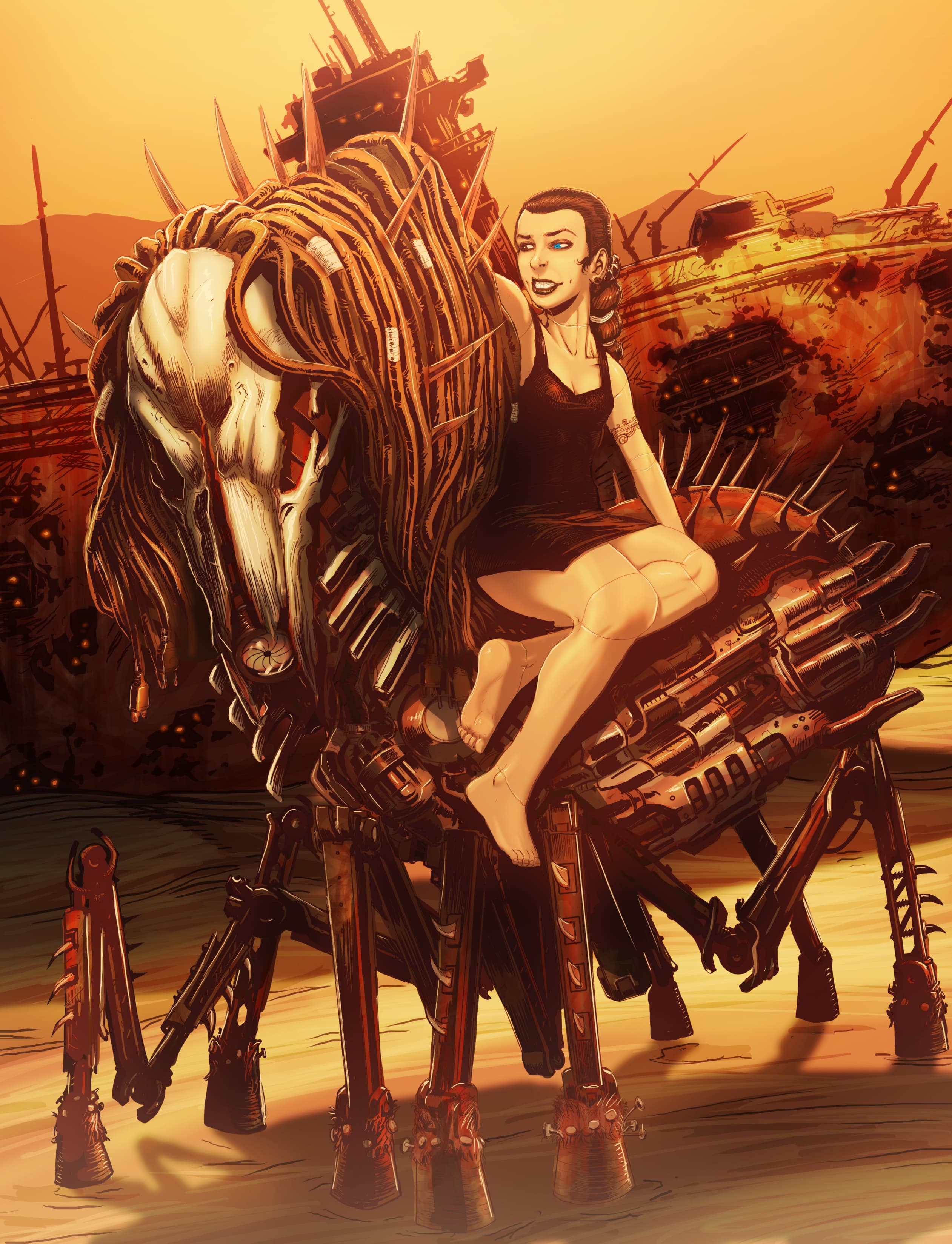
We'll be using adult Morta for this commission and all her prior points apply save for a few minor differences detailed below.
Igor: He is Morta's personal attendant and was made from her rib. He is technically an advanced Gnatu similar to Bastion and armed to the teeth. As he is an older model, his camera lens is dated and he looks far more menacing. Morta had a hand in his design and she was inspired by mythological interpretations of the pale horse with a healthy enthusiasm for spiders. Igor is a mechanical cross between a horse and a black widow. Eight legs with hooves instead of paws, fangs, a mane made of extension cords, and an abdomen of interchangeable parts, gears, and spinning screws.
In this scene, Morta is riding on his back side saddle. Igor is about the only creature/person/thing that she acts lady-like for, dropping her usual cold demeaner and letting her hair down. Igor is Morta's pale horse and he is a force to be reckoned with especially to anything that might threaten his mistress.
As for the background, Morta's home is her personal battleship, the Yamato. An old historical Japanese battleship that sunk when its munitions hold exploded. The Gnatu have stitched the remains of this battleship into the garden and Morta patrols its halls on the back of Igor, lost in thought. The other Gnatu are terrified of her and hide beneath every crack, crevice, empty bullet casing, and loose porthole they can find.
If you’ve made it to the end and found your way here, you’re probably curious about what you just read. I’m glad you are. Let me walk you through these pieces in the author’s notes below which includes some of my original concept artwork:
This chapter marks our first true introduction to Gama. More importantly, it serves as another example of the temporal shifts that occur throughout the narrative. We encounter Morta here as an adult and learn something that would have seemed impossible only a few chapters ago: Gama is her daughter.
For those paying close attention, this revelation lends credibility to a much earlier prediction. Long ago, a young Nona insisted that Morta would one day become a mother. At the time, Morta dismissed the idea outright. Given her nature as a stillborn child and duchess of death, the notion seemed absurd.
And yet, here we are.
Exactly how a stillborn deity managed to bear a child remains a mystery for now, but we do learn something important about Gama herself. She suffers from the same illness that afflicted Adelaide and her descendants. The Mangle.
That detail tells us quite a lot. It means Gama is a half-breed.
A rather unpleasant term, admittedly, but an accurate one. Gama is part divine and part mortal. While the identity of her father remains unrevealed, the evidence strongly suggests that he belonged to Adelaide's mortal lineage.
We also learn that Gama has become a champion of death. Unlike many of her kin, she actively seeks to restore mortality to the peninsula, a goal that places her in direct conflict with many of the powers around her. If you've seen how Morta treats her daughter throughout this chapter, you may already have some idea how complicated their relationship has become.
For now, however, much of Gama's story is best left shrouded in mystery.
Instead, this seems like a good opportunity to discuss something that has appeared repeatedly throughout the series: the noble titles used by the lesser gods.
By now, you have likely heard Morta, Decima, and Nona referred to as duchesses. These titles are not merely ceremonial. Among the lesser pantheon, rank is directly tied to divine authority and proximity to the upper gods.
At the top of the hierarchy stand the Dukes and Duchesses.
These are the most powerful members of the lesser pantheon and the only rank capable of ascending into the ranks of the upper gods. If you've read The Pallid War, you may notice that many of the Engineers of Kath'le Kal occupy a comparable station.
Below them are the following ranks:
Duke / Duchess: The highest station within the lesser pantheon.
Marquess / Marchioness: Typically one generation removed from ducal bloodlines.
Earl / Countess: Usually two generations removed.
Viscount / Viscountess: Three generations removed.
Baron / Baroness: The lowest recognized rank, often four or more generations diluted. On rare occasions, mortals may be elevated to this position.
Beyond these ranks lies a unique transitional title: Daemon Sultan.
Despite the name, this rank functions much like a prince or princess. It represents a deity standing on the threshold between the lesser and upper pantheons—a being awaiting admission into the greater hierarchy.
Once ascended, the titles change entirely.
The upper pantheon follows the structure of a cosmic chessboard. Power ascends through the ranks of Pawn, Rook, Bishop, Knight, King, and Queen. While the terminology may sound deceptively simple, even a Pawn possesses authority that vastly exceeds that of nearly every lesser deity.
The gap between the two pantheons is immense.
As of this point in the chronology, only a single duchess has ever successfully ascended into the ranks of the King's Game.
Though titles may shift over vast spans of time, promotion is exceedingly rare. Power is not granted lightly, and those who occupy the highest stations have usually earned them through centuries—or millennia—of sacrifice and survival.
In other words, the hierarchy is fluid, but it is not forgiving.
Putting this in terms that is relevant for this chapter. Gama would be considered a Marchioness, one generation dilute from a true duchess, but even a Marchioness manifested a blade of Kath’le Kal. Now that is a story for another time.