Gooday everyone,
Welcome to the Deacon Corner. If you’re new here, this space dives into the inspirations behind the images you’ll find throughout the books on these pages. What began as a place to share commission breakdowns has grown into something more. In addition to detailing how each piece came to life, you’ll now find expanded chapter notes, lore entries, and my own black-and-white concept illustrations which are raw glimpses into the ideas that shaped this world before they fully took form.
Before we begin, it’s important to say that none of the beautiful stylized images found in the hard and soft copies of these books would exist without the incredible talent of Sickjoe who is quite literally the heart and soul of this visual world. If you appreciate his work as much as I do, I highly encourage you to visit his gallery and explore more of his creations.
Now, without further ado, let’s take a look at the featured image and learn a bit more about the lore hidden in this chapter.
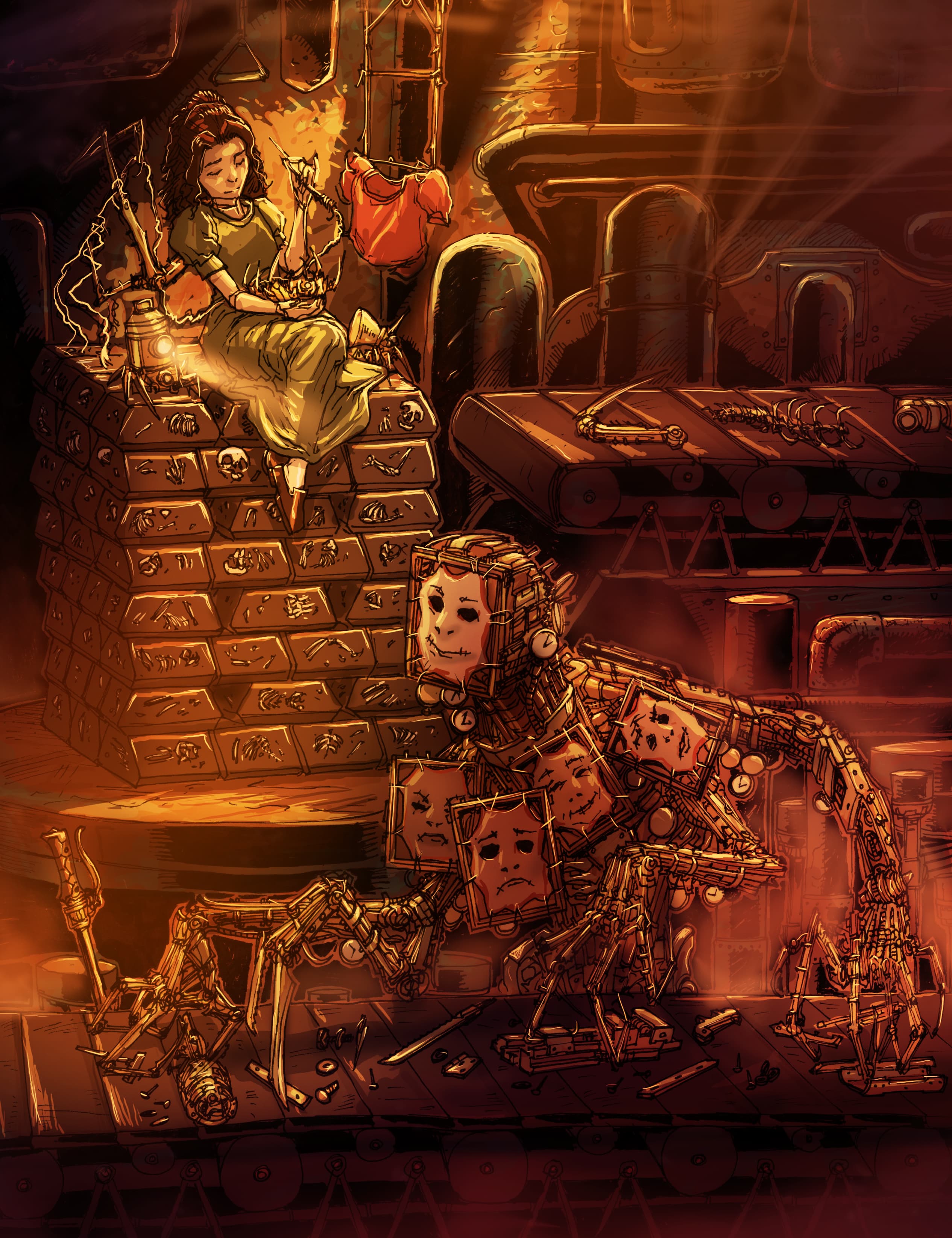
We've got pieces for Tyke Morta and Decima, now I need one for Tyke Nona. This one will also serve as an introductory piece for her conduit, Charon. In this scene, we see how the second generation Gnatu are made, crafted from molten iron ingots, and the fates of stillborn infants. Nona weaves the tattered fate of the unborn and pieces together a fabric she embeds within the iron shell of a larval Gnatu. Unlike mortals, the Gnatu carry fate within their bodies never to be touched by the Isomerase.
Background: We are visiting a place called the orphanage. It is a massive steam-powered engine room run by pistons, hot water, and fire. Think of the piston power engine room of luxury ocean liners like the Titanic. Small human bones embedded in iron ingots are stacked all around and a conveyor belt runs pieces of metal through the white-hot flames to be shaped into fingers and claws, guns, and blades. Similar to the kitchens, there are Gnatu down here, but instead of pots and pans, they wear toolboxes, lanterns, oil, and gas cans. As an added detail, the Gnatu who get too close to Nona behave like children, crawling around on their bellies and sucking on their fingers. Just like Morta and Decima, Nona unconsciously emits a dog whistle that drives the Gnatu to behave in ways that please her... In Nona's case, they act like toddlers.
Nona: She's a child in this piece, dabbling in an unusually mature art. She sits on mounds of iron ore and we can see bones embedded in the metal—skulls and femurs of small children who never had a chance at life. The tattered remains of fate still cling to the bones, the leftovers of the tapestry that Morta cut from the Isomerase (Think of the 'DNA' chains you designed for the prior isomerase pieces and what those would look like cut). Nona gathers these remains with the needle from her neck and crafts a new tapestry from the sparks of ephemeral life.
Despite the unusually macabre nature of the scene, Nona is quite cheerful, with a smile and a blush, she weaves swaddling clothes for a baby boy. Nona intends to embed the knitted fate into the molten half-shaped metal shell sitting in her lap (The larval beginnings of a Gnatu). Sparks bounce off her skirts like water against wax paper and the flames of the heated metal do not affect her. As a daughter of Iapyx, by law, neither she nor her sisters can be harmed by flames.
Charon: Charon is to Nona like Igor is to Morta. However, while Igor takes the shape of a steed with a scarlet hourglass, Charon takes the form of a butler and husband. The conduits evolve to suit their master's will and Nona's will is that of a budding mother, a closet tomboy, and a romance novel enthusiast obsessed with the concept of unrequited love between master and servant. However, as innocent as Nona's thoughts may be, Charon takes the appearance of a badly misinterpreted Vitruvian man. Multiple arms jut from his exposed copper exoskeleton and he wears human faces over his lens, the leathery cheeks of mortal men stretched over a wooden frame. He has a mask for every expression, happiness, sadness, anger, concern, etc. The excess masks dangle from his neck and shoulders. Pocket watches hang from his vertebrae and tools erupt from his wrists as he works on the legs, eyes, and teeth of the unborn Gnatu coming down the conveyor belt. He is, for lack of a better descriptor, a mechanical, multi-armed Leatherface with the exposed endoskeleton of a terminator. Still, as frightening as he is, Nona is completely at ease around him. In many ways, I'm drawing inspiration from the game Bioshock and the relationship the little sisters had with the big daddies. Seemingly innocent little girls collecting necrotic material from corpses all the while holding the hands of a grotesque monstrosity who they saw as their father.
If you’ve made it to the end and found your way here, you’re probably curious about what you just read. I’m glad you are. Let me walk you through these pieces in the author’s notes below which includes some of my original concept artwork:
On the Orphanage and the Birth of the Gnatu
This week feels like an appropriate time to discuss the orphanage.
In this chapter, we glimpse one of Nona’s stranger hobbies, though hobby may be too gentle a word. She has quietly inherited the duty of constructing new Gnatu and, for the first time, we witness how the second generation comes into being.
Not the first generation. The distinction is important; the first generation's origins belong to an older and far uglier story.
Here, Nona and Charon work together to shape a fledgling Gnatu from scraps of taconite. At first glance, the process appears almost innocent. Childlike, even. Until we learn what lies inside the metal.
Human bones. More specifically, infant bones.
The remains of stillborn children are embedded within the Gnatu’s frame, and with them, Nona weaves something stranger still: fragments of broken fate. If this sounds similar to the necromancy pioneered by Decima, you are not mistaken. The resemblance is intentional. But there is one important distinction.
Necromancers manipulate echoes of lives already lived. Their spirits are recordings, moments replayed from a path that reached its conclusion.
Nona works with something entirely different. Potential. A stillborn child possessed twelve seams just as any mortal would have. Twelve possible lives. Twelve futures. Twelve choices. None of them came to pass. Nona does not animate what was but cultivates what never became.
The unused strands of unlived futures become the fate of a second-generation Gnatu. This changes how we should think about these little machines entirely.
The Gnatu are living manifestations of abandoned possibility. The choices never taken. The lives never lived.
In contrast, necromancy concerns itself with the final echoes of completed lives. Both arts manipulate fate, but from opposite ends of existence.
One deals in endings and the other, in absences.
Still, there is a curious similarity between entities such as Harmon Grieves and the Gnatu. Both carry their fate within themselves. This is unusual.
As we know, mortals are largely divorced from their own fates, which reside instead within Iapyx’s singularity at the heart of the Garden. Yet constructs born from fragmented destiny seem to internalize the weave. They become both vessel and thread simultaneously.
The orphanage itself reflects this contradiction. Like much of the Garden, it is built from the remains of a sunken vessel.
Each of the Sisters maintains quarters of her own near the Cathedral, and Nona’s domain lies within a region known as the Cliffs of Sidhe. There, stranded upon jagged stone, rests the vessel housing the orphanage—a place where abandoned possibilities are given shape.
What this chapter does not mention directly is perhaps the saddest detail of all: Near the bow of her vessel, overlooking the cliffs, Nona keeps a graveyard for stillborn children.
She considers each death a personal failure and spends countless mornings reciting the names of those she could not birth. Over centuries, she has become something akin to a living encyclopedia of stillborn children. Remember this when considering her relationship with Morta.
Their tension begins to make more sense. Morta trims the threads, and Nona mourns them. The burden of death looks very different depending on where one stands.
This chapter also introduces one of Nona’s quieter rituals.
When a new Gnatu is born, she chooses its adoptive parents.
Across the Garden, hopeful couples leave their chimneys lit, coals burning warm in expectation. Nona descends in the night and delivers the newborn through the hearth itself. In this strange way, she has become something resembling the old mortal legends: A stork carrying children.
Only here, the child arrives in a cradle of iron, smoke, and ash, landing among warm embers to be welcomed by an adoptive family.
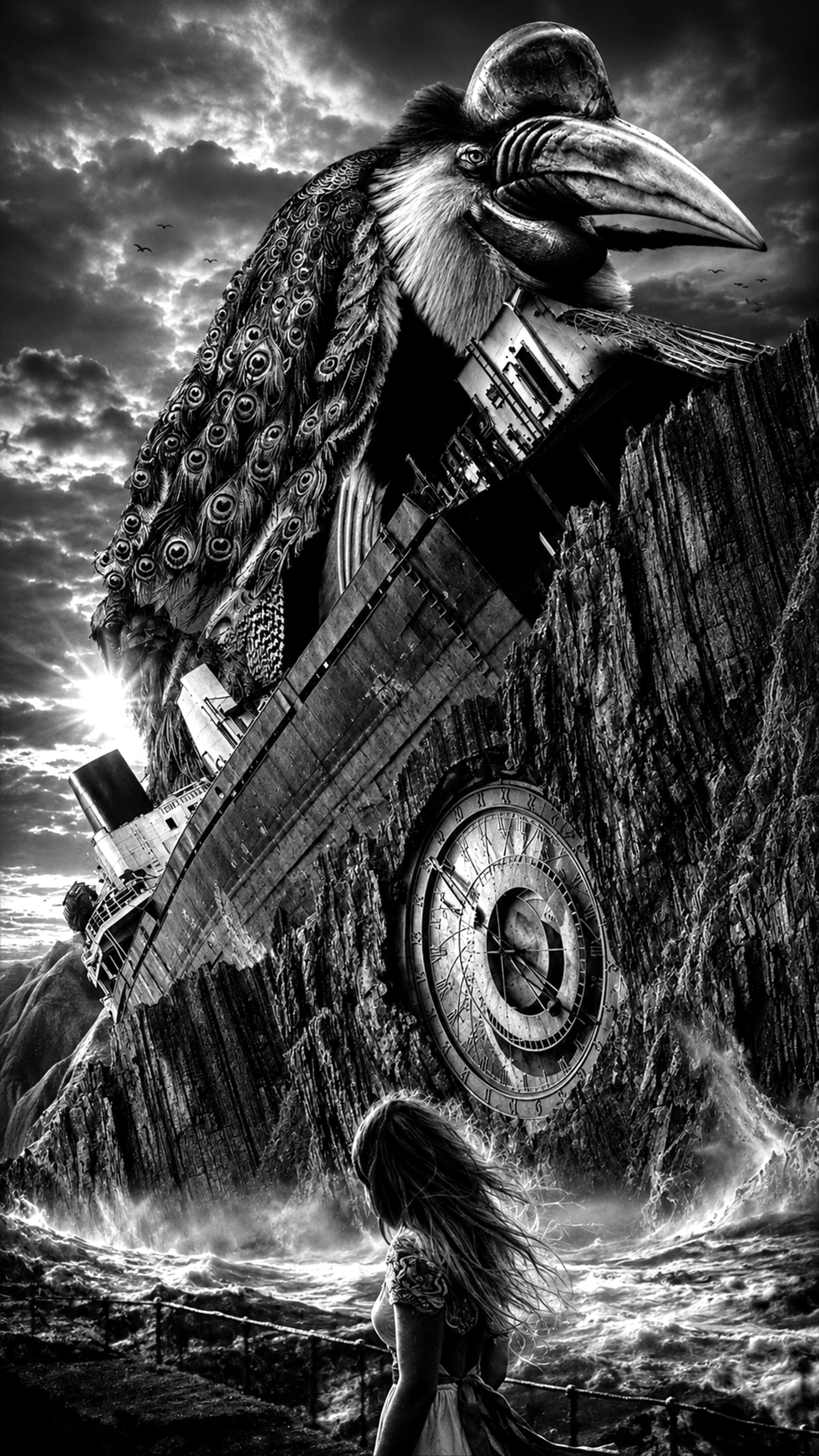
As for the artwork, we see an older Nona wandering the deck of a neighboring vessel drifting through shallows of sulfur and molten glass. Beyond lies the Cliffs of Sidhe, and embedded within the stone is a clock known as Eternity’s Second Hand.
It counts down to the collapse of Iapyx’s constructed singularity. The beginning of the end. The first tick toward Ragnarok.
And then there is the bird. Some of you may remember what the fledgling Gnatu asked Nona in this chapter:
I want to be a bird.
Don’t worry. We’ll get to Nona’s children, but that is a story for another time.