Gooday everyone,
Welcome to the Deacon Corner. If you’re new here, this space dives into the inspirations behind the images you’ll find throughout the books on these pages. What began as a place to share commission breakdowns has grown into something more. In addition to detailing how each piece came to life, you’ll now find expanded chapter notes, lore entries, and my own black-and-white concept illustrations which are raw glimpses into the ideas that shaped this world before they fully took form.
Before we begin, it’s important to say that none of the beautiful stylized images found in the hard and soft copies of these books would exist without the incredible talent of Sickjoe who is quite literally the heart and soul of this visual world. If you appreciate his work as much as I do, I highly encourage you to visit his gallery and explore more of his creations.
Now, without further ado, let’s take a look at the featured image and learn a bit more about the lore hidden in this chapter.
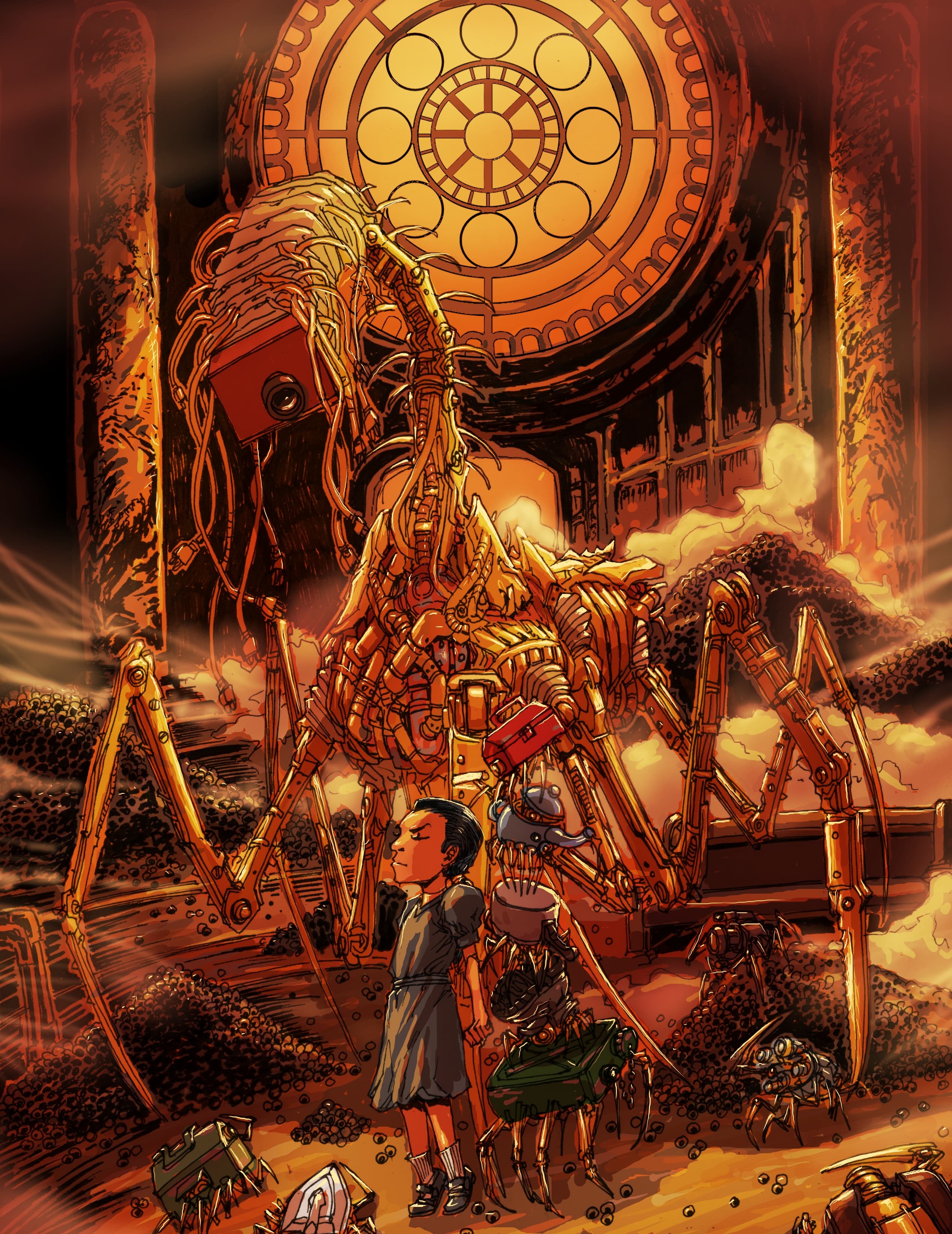
I need a piece between Morta and Igor in the cathedral but, this time, as children.
Igor: When Igor first manifested as a conduit for Morta, he wasn’t quite as menacing a steed as he would later become. In the beginning, he looks like an oversized daddy-long legs spider with much of his inner workings exposed revealing the open guts of a clock. He has no skull to cover his lens, no saddle, or hooves. A conduits development reflects the maturity of their charges and so, given Morta’s age, he’d be rather crudely assembled here, free wiring and an exposed oil filter, etc.
Morta: Tyke Morta is standing in front of one of Igor’s legs, pressing her back against him, level to his knee. You know those moments when children measure their height by striking marks against a doorframe? Morta’s using Igor for that, but she stands on her tiptoes trying to cheat the system, rather frustrated by her stunted growth in comparison to him. Next to her, a group of smaller Gnatu have climbed atop one another, forming an unsteady tower, the top most machine drawing a chalk mark on Igor’s leg just above tyke Morta’s head.To her dissatisfaction, even on her tiptoes, she’s a great deal smaller than him…
Background: We just need the cathedral backdrop for this one. Pews, metal pipes, mounds of taconite and plenty of steam. The Gnatu not roped into measuring Morta’s height, gather around saluting her from the shadows, beneath the pews and taconite, forever toy soldiers in a little girl’s playroom.
If you’ve made it to the end and found your way here, you’re probably curious about what you just read. I’m glad you are. Let me walk you through these pieces in the author’s notes below which includes some of my original concept artwork:
On the Cathedral and Iapyx’s Original Sin
For this session, we turn to the Cathedral of Fate and learn that it is an instrument far more dangerous than first implied.
By now, we understand the broad mechanics of fate and the role of the Isomerase. But beneath that system lies a fracture point, a moment of transgression that reshaped everything within the Garden: Iapyx’s original sin.
We have spoken before of the war between Iapyx and Daedalus, and of Iapyx’s attempt to kill his brother. What we have not fully explored is why.
At some point, Iapyx learned to read his own fate. This, in itself, was a violation.
The fate of mortals and the fate of the divine are not governed by the same rules. Iapyx, for all his dominion over time, space, and human destiny, holds no authority over the weaving of divine fate. That power belongs to the elder pantheon, entities that define the underlying architecture of existence itself. Beings such as the Great Devourer and the Basilisk do not merely exist within perceived natural law; they are its authors.
It may seem counterintuitive that something as blind and ravenous as the Devourer holds such authority, but the upper pantheon does not operate on mortal logic.
And yet, Iapyx defied them.
The Cathedral, and by extension, the Garden, was not originally built to govern human fate. It was constructed as a means to read and write the fate of the divine. A forbidden ambition. An attempt to trespass into a domain that was never his to touch. For this, he was punished, but not before he succeeded.
Iapyx looked into the tapestry of his own existence and saw the truth waiting at its end: he would die by his brother’s hand. Fear followed, and in fear, he turned to action.
In attempting to escape his fate by striking first and attempting to kill Daedalus, he ensured its fulfillment. The war, the poisoning of Adelaide’s kiln, the unraveling of the Garden… all of it traces back to that single moment of defiance.
This is the sin the Sisters of Fate have been warned never to repeat. And yet, in this chapter, Morta comes dangerously close.
Driven by the desire to save Nona from a mortal end, she reaches beyond her station. For a brief moment, she glimpses the realm of the upper pantheon, committing the same trespass as her father.
One might wonder why the elder deities do not intervene. The answer is unsettlingly simple. They allow it.
Free will is not forbidden, but it is not without consequence. To defy the architects of reality is not something easily forgiven, nor easily survived. Morta’s act also reveals something critical about the Cathedral itself. It is more than just a vessel housing the singularity of human fate.
Through it, one may brush against the awareness of beings like the Basilisk. Communication, if it can be called that, is possible. But to draw their attention is to invite annihilation. Entire factions within the wider narrative exist solely to avoid such notice, but Morta seeks it. And in doing so, she uncovers something else, something deeply unsettling about the nature of divine fate. Unlike mortal threads, which hang in ordered strands beneath the Isomerase, divine fates appear elsewhere.
Morta glimpses them suspended within a gluttonous rift, drawn through the open maw of something vast and unknowable. It suggests that divine fate is not woven at all, but embedded within the living structure of the Great Devourer herself—perhaps along the smooth muscle of her throat.
This aligns with what we have already seen in The Pallid War.
The engineers drew their names of power from that very place. Persephone, in particular, secured her authority from the lining of her mother’s throat, a detail that now carries far greater weight.
If mortal fate is woven… then divine fate is digested, and this raises an uncomfortable question.
Lesser gods are not eternal. They fade, fracture, and disappear over spans of time far longer than mortal lives, but finite nonetheless. So what becomes of them? When a deity “dies,” what remains?
Are their fractured fates reborn in some altered form? Do they return as something akin to the engineers of Kath’le Kal, just as discarded mortal fate gives rise to the Gnatu? Or are they simply consumed, absorbed into the endless hunger that underpins everything?
For now, we do not have a definitive answer. But the Question lingers, and in a world where fate itself can be unraveled, rewritten, or devoured… it is not a comforting one.
